










.01
Work Information
Curriculum Vitae
- Was a member of the Indian Administrative Service (IAS) for thirty four years (1982-2016). Last position equivalent to Secretary to Government of India.
- Held several important assignments under both the Union and State (Kerala) governments, including multiple stints in the Treasury departments where I was responsible for budget formulation and management, interface with multilateral financial institutions such as the World Bank, IMF and UNDP, and regulating access to international financial markets.
- Masters (with distinction) in Macro-economic Policy, University of Bradford, U.K., and PhD in Economic History, Jawaharlal Nehru University, New Delhi, India.
- Diplomatic experience as Counselor Economic in Washington DC and later Chaired the SAARC Development Fund in Bhutan.
- Senior level macro-economic policy advice experience as Secretary, Prime Minister’s Economic Advisory Council.
- Senior level multilateral interlocutor in the G 20 from the first Summit in Washington DC (2008) to the seventh Summit in Los Cabos, Mexico (2012), at the height of the Global Financial Crisis:
- Anchored both the Finance Ministers and Central Bank Governors (FM&CBG) and Sherpa channels on the Indian side. Represented the Indian finance deputy and acted as sous Sherpa at the G 20 table, directly and actively participating in the deliberations and communique drafting.
- Co-chaired, along with Canada, the flagship G-20 Working Group on Strong, Sustainable and Balanced Growth.
- Set up and headed the India G-20 Secretariat in India and anchored inter-departmental coordination for participation in various G 20 work streams.
- Prepared background notes, policy/strategy papers, record of G 20 deliberations, and briefing notes for the Indian Finance Minister and Prime Minister.
- Part of the Indian PM’s official delegation for G 20 Summits.
- Widely travelled and resourced for international conferences and workshops on the global economy, the G 20, economic governance and the international monetary system.
- Several full length articles in books and journals. Regular commentator on economic issues, in Economic and Political Weekly (EPW) and the East Asia Forum. About 200 opinion pieces in The Economic Times, Financial Express, Business Standard, Mint, Indian Express, Financial Times (London). Full list/ downloads: http://www.aloksheel.com/pap_pub.htm
Much of this is on the G 20 and the Global Financial Crisis, including a full length book: ‘Rethinking Macro-economics 101: A Ringside View of the Global Financial Crisis from Asia in Real Time’ (Academic Foundation 2015)
http://academicfoundation.org/index.php?route=product/product&product_id=570
.02
Work Experience
14.01.2019 to 14.01.2022
RBI (Reserve Bank of India) Chair Professor in Macroeconomics, Indian Council for Research in International Economic Relations (ICRIER), New Delhi
29.02.2015 to 31.5.2016
Additional Chief Secretary, Government of Kerala, Planning and Economic Affairs, Trivandrum Member Secretary, State Planning Board, Special Representative Niti Ayog and Union Finance Ministry, New Delhi
10.10.2012 to 1.12.2014
Secretary, Prime Minister’s Economic Advisory Council, Government of India, New Delhi, India.
23.10.2008 to 10.10.2012
Joint Secretary, Department of Economic Affairs, Ministry of Finance Government of India, New Delhi, India
2.7.2007 to 22.10.2008
Secretary, Prime Minister’s Economic Advisory Council, Government of India, New Delhi, India.
25.7.2006 to 30.6.2007
Principal Secretary to Government of Kerala, Planning and Economic Affairs Department, and Member-Secretary, State Planning Board, Trivandrum, Kerala, India.
30.8.2005 to 24.7.2006
Secretary to Government of Kerala, Finance (Resources) Department, Trivandrum, Kerala, India
1.8.2005 to 30.8.2005
Secretary to Government of Kerala Labour and Fisheries Departments, Trivandrum, Kerala, India
22.1.2004 to 31.7.2005
Secretary to Government of Kerala Water Resources Department, Trivandrum, Kerala, India
1.9.2000 to 3.12.2003
Counsellor (Economic), Embassy of India, Washington D.C, U.S.A
22.10.97 to 22.8.2000
Director, Government of India, Department of Mines, New Delhi
20.11.95 to 20.10.97
Secretary to Government of Kerala, Finance (Expenditure) Department, Trivandrum, Kerala, India
25.9.94 to 30.9.95
M.Sc in Macro-Economic Policy & Planning in Developing Countries.University of Bradford, U.K)
16.12.91 to 9.9.94
Deputy Secretary (ECB) to Government of India, Department of Economic Affairs, Ministry of Finance, New Delhi, India
24.8.90 to 16.12.91
Under Secretary to Government of India, Cabinet Secretariat, New Delhi, India
4.6.90 to 23.8.90
Joint Secretary to Government of Kerala, General Administration Department, Trivandrum, Kerala, India
14.3.89 to 4.6.90
District Collector and District Magistrate, Pathanamthitta District, Kerala, India
1.9.86 to 13.3.89
6.3.85 to 31.8.86
10.9.84 to 6.3.85
.03
Hot list
Publications
- Arts and Letters Daily
- Business Line
- Business Standard
- CNN
- Financial Express
- Mint
- Samachar
- The Economic Times
- The Economist
- The Financial Times
- The Indian Express
- The Times of India
- The Hindu
- The Hindustan Times
- The New York Review of Books
- The New York Times
- The Princeton Review
- The Washington Post
- Wall Street Journal
Multilateral
- European Union Statistics
- Global Environment Facility Homepage
- Harvard Institute of International Development
- IFC Homepage
- IMF Homepage
- UNCTAD Homepage
- UNDP Homepage
- United Nations Homepage
- Water and Sanitation Programme
- World Bank Homepage
- WTO Homepage
Indian Websites
- Ajay Shah’s Homepage
- Bombay Stock Exchange Homepage
- Central Statistical Organization
- Centre for Monitoring the Indian Economy
- Centre for Policy Research
- CII Homepage
- Commerce and Industry: India
- Confederation of Indian Industry Homepage
- CRISIL Homepage
- Digital South Asia Library 41.
- Districts of India
- Economic Survey of India and Budget
- FICCI Homepage
- Foreign Trade statistics
- Government of India
- Government of Kerala
- Guidelines for Investment in India
- HINDALCO
- Income Tax Department India
- India GIS
- India Vision 2020
- India: Drinking Water
- Indian Agricultural Statistics
- Indian Banking Sector
- Indian Census
- Indian Civil Service Postings
- Indian Controller General of Accounts
- Indian Council for Research on International Economic Research
- Indian Embassy in USA
- Indian Oil Corporation
- Indian Planning Commission
- Indian POL statistics
- Indian Population Commission
- Indian Power Statistics
- Indian water statistics
- Infosys Technologies
- Institute of Economic Growth
- Insurance Regulatory and Development Authority of India Homepage
- Jawaharlal Nehru University
- Larsen and Toubro Ltd.
- Library of Congress India Office
71b Macroscan
- MALCO
- NALCO
- NASSCOM
- National Accounts
- National Council for Applied Economics Research
- National Informatics Centre of India Homepage
- National Institute of Public Finance and Policy
- NSSO
- National Stock Exchange of India Homepage
- Privatization In India
- Ranbaxy Industries
- Reliance Industries
- Reserve Bank of India Homepage
- SEBI Homepage
- TERI
- US India Business Council Homepage
International
- Aluminum Association
- American Civil Liberties Union
- American Enterprises Institute for Policy Research
- American Institute of Certified Public Accountants
- Angus Maddison's Homepage
- Arts and Letters Daily
- Association of Certified Fraud Examiners
- Baker Institute
- Bank of International Settlements
96A. Bloomberg
100.Centre for Strategic and International Studies
100a China: National Bureau of Statistics
100b China: US China Business Council
100c China: People’s Bank of China
101 Council on Foreign Relations
103.Food and Agriculture Organisation
104.Fitch Ratings
106.Hoover Institute
106A International Swaps and Derivatives Association (ISDA)
108.LIBOR data
111.Markit
114.Metal Prices
117.Morgan Stanley
118.NASDAQ
119.NBER
122.Pew Research Centre for the People and the Press
123.Polling Report
124.Rand Corporation
125.Rogers International Commodity Index
125a Securities Industry and Financial Markets Association (SIFMA)
127.Stratfor
127A. TED spreads
130.US Treasury Department Homepage
131.US Department of Transportation Homepage
132.US Federal Communication Commission Homepage
133.US Department of Energy Homepage
134.US Commerce Department Homepage
135.US Department of Agriculture
138.USAID
139.US Securities Exchange Commission
144.Yahoo Finance
Search
.04
Current Projects
This is my PhD dissertation, parts of which has been published in the form of papers (IESHR, see below). I hope to re-work this into a book, which would attempt to describe and analyse the transformation of rural society during the six decades of Pax Britannica following the 1857 Revolt. Since this part of Bihar is currently in great social ferment, characterised by extreme forms of violence, I expect this also to be a work of contemporary history that throws some light on the makings of rural society in this region.
A Contemporary History of India
The History and Future of Globalization
Major Economic Policy Issues for India in the New Millenium
.05
Full Length Articles
Full Length Articles/Books
- "When Elections are Not Enough", The India Forum, September 20, 2026. (PDF file)
- "The Iran Question: War, Regime and the Price of Intervention", The Wire, August 24, 2026. (Print Version)
- "Can India become a developed economy and catch up with China? Three Scenarios", The Wire, March 4, 2023. (Print Version)
- "Don't Judge the past in relation to the present", The India Forum, January 20, 2023 (Print)
- The G20: An Agenda for Indonesia (2022) and India (2023), in Ali Mehdi & Zaki Khan (ed) Tracking and Tackling Covid-19. Global Perspectives, Global Development Press, 2022 (Chapter 7)
- "Evolution of the G 20 and India's Upcoming Presidency", in G 20 @ 2023 India's Presidency. Two Essays, Indian Council of World Affairs , October, 2022
- "Assessing Recent Indian Growth", Economic and Political Weekly, Vol. 57, No.34, August 20, 2022
- "An Alternative Theory", Review of Madhusudan Datta, Reform and the Structure of the Indian Economy (with Vrinda Saxena), The Book Review, Vol. XLVI Number 1, January 2022
- "Multilateralism, the global economy and the rise of the G20", Indian Council of World Affairs, June 2021.
- "The India Economy: Covid 19 and Beyond", Economic and Political Weekly, Volume 56, No.21, May 22, 2021.
- "The Ballad of Raisina Hill", Postscript, Economic and Political Weekly, Volume 56, No.18, May 1, 2021. PODCAST
- "Modern Monetary Theory, Deglobalization and the Dollar", Economic and Political Weekly Vol 56, No. 10, March 6, 2022
- "The G 20 and the Global Financial Architecture", Research and Information Systems, G 20 Digest, Vol 2, No.2, September-November 2020, pp. 25-32.
- "Comorbidities and the Indian economic recovery", The India Forum, issue November 6, 2020
- "Evaluating Global Financial Architecture and Regulatory Practices -- Progress and the Way Forward", October 5, 2020 (Monday) from 17.00 – 18:30 Hrs (IST). ICRIER’s 12th Annual International G20 Conference titled “Protecting Human Lives and Restoring Economic Stability: Views from the G20 Members” October 5-8, 2020. Youtube
- "Covid-19 Stimulus and Atma-Nirbhar Abhiyan", The Stimulus Package in Five Installmemts Does it Make the Economy More Self Reliant?, Centre for Development Studies Trivandrum, Commentary on India's Economy and Society Series # 15, June, 2020
- "The Global Economy and Financial Markets 10 Years after the Global Financial Crisis", in Rajat Kathuria & Prateek Kukreja ed. 20 Years of G 20: From Global Cooperation to Building Consensus, Springer 2019.
- “Infrastructure and Fiscal Management”, (With Narayana Delampady) Economic and Political Weekly, Vol 53, No.20, May 19, 2018
- “Economic revival or Dead Cat Bounce?”, Economic and Political Weekly, Vol 53, No.9, March 03, 2018
- The Rupee Stops Here”, Review of I Do What I Do by Raghuram R Rajan, Harper Collins, 2017 pp. xvi and 325. The Book Review, December 2017
- “A Farewell to Arms”, Economic and Political Weekly, Vol 51, No.31, July 30, 2016
- “Demystifying Indian Growth”, East Asia Forum, June 23, 2016
- ”Monetary Policy Dilemmas at the Current Juncture”, Economic and Political Weekly, 51, No. 12, March 19, 2016
- “Will India lead the next wave of global economic growth?”, East Asia Forum, March 16, 2016
- “How to pass the baton of global power”, East Asia Forum December 1, 2015
- “Global Growth: Is the Framework for Strong, Sustainable and Balanced growth still relevant?” The Future of International Governance and the G 20, ed. Michael Callaghan and Tristram Sainsbury, Lowy Institute, 2015.
- Looking Back at Macroeconomics 101: A Ringside View of the Global Financial Crisis from Asia in Real Time, Book, Academic Foundation, October 2015. Contents Reviews: 1. Business Standard March 11, 2016 (Print Version) 2. The Financial Express May 1, 2016 (Print Version) 3. Economic and Political Weekly, June 11, 2016 (Print Version)
- International Financial Regulatory Reform: A Mid-term Assessment from an Emerging Market Perspective (With Meeta Ganguly) in) Kathuria, Rajat & Nagpal, Neetika Kaushal, ed, Global Economic Cooperation: Views from G 20 Countries, Springer, 2016 Part IV : Reforming the Global Financial System: Implications for long-term investment finance, 167-209.
- “ How the Reserve Bank of India escaped the central banking crisis”, East Asia Forum, October 8, 2015.
- “China, India and Global Headwinds”, East Asia Forum, August 25, 2015.
- ”Deconstructing Indian Monetary Policy Through the Taylor Rule”, Economic and Political Weekly, 50, No. 34, August 22, 2015
- “Agricultural Trade and Markets in British India: Shahabad and Gaya Districts, 1800-1920,” Indian Historical Review, Vol 42.1 June 2015.
- “Public Financial Crisis”, Review of Financial and Fiscal Policies. Crises and New Realities by Y.V.Reddy, Narayan Valluri and Partha Ray, Oxford University Press, New Delhi, India. 2014. pp. xviii and 344. Economic and Political Weekly, 50, No. 17, April 25, 2015.
- “Asian Review: An Indian Resurgence. Will Modi’s Arrows Hit the Mark?”, East Asia Forum Quarterly, 7, No. 1, Jan-Mar 2015, Minorities in Asia (Crawford School of Public Policy, Australian National University, Australia) pp.13-16. Longer version published as ‘Challenges for an Indian Resurgence’ in Policy Audit
- “Quantitative Easing and the Helicopter Drop: Macroeconomic Policy Beyond the Zero Bound”, Economic and Political Weekly, 50, No. 11, March 14,2015.
- “Emerging Markets and International Financial Institutions: Looking Ahead”, Yojana, February 2015, pp.17-20.
- “Unravelling of the Bretton Woods Twins”, Economic and Political Weekly, 49, No. 42, October 18, 2014.
- “The New Triad of Policy Concerns”, Review of Monetary Policy, Sovereign debt and Financial Stability: The New Trilemma, edited by Deepak Mohanty, Reserve Bank of India 2014, Foundation Books, Cambridge University Press, India. Pp. i-xiv and 1-370. Economic and Political Weekly, 49, No. 23, June 7, 2014.
- “The Challenges in IMS Reforms: An Emerging Markets’ Perspective”, The G20 Macroeconomic Agenda : India and the Emerging Economies, ed. Parthasarathi Shome, Chapter 8. Cambridge University Press, 2014.
- “The Unravelling of Inflation Targeting”, Economic and Political Weekly, 49, No. 20, May 17, 2014.
- “India’s Three Arrows”, Yojana, Vol. 58, April 2014.
- “Global Spill Overs and EMEs”, (session 1) “EMEs’ Response to Global Spill Overs” (session 2), at the High Level Round Table on Finance: Monetary and Regulatory Spill Overs on Emerging Markets and Developing Countries, Blavatnik School of Government, University of Oxford, February 12, 2014.
- “The Operation of the G 20 to date: Emerging Country Perspectives”, (with Changyong Rhee, Chief Economist, ADB), in Kemal Dervis & Peter Drysdale, ed., The G 20 Summit at at Five: Time for Strategic Leadership, Brookings Institution Press, July 2014.
- “A Monetary Policy Rule for Emerging Market Economies: The Impossible Trinity with the Taylor Rule”, Economic and Political Weekly, 49, No. 04, January 25, 2014.
- “G 20 and the Policy Response to the Global Financial Crisis” Michael Callaghan, Chetan Ghate, Stephen Pickford and Francis Rathinam, Global Cooperation Among G20 Countries: Responding to the Crisis and Restoring Growth (Springer, New Delhi, Dordrecht, Heidelberg, London, New York 2014) Part VI. Austerity and Growth. (pp. 241-280)
- “Resurgence and Limitations of Keynesianism”, (with C.Rangarajan) ed. Raj and Uma Kapila, Economic Developments in India, Volume 191, Academic Foundation, 2013. Chapter 2, pp. 25-30.
- “Relevance of Keynesianism in the Post Recession Period,” (with C.Rangarajan), Economic and Political Weekly, 48, No. 32, August 17, 2013.
- “Macro-economic Policies for India’s Growth Crisis” , Economic and Political Weekly, 48, No. 19, May 11, 2013.
- “Growth or Austerity: The Policy Dilemma” (with C.Rangarajan), ICRA Bulletin, Money and Finance, February 2013)
- “IMF and the Eurozone: A Developing Country Perspective” Economic and Political Weekly, 47, Issue No.52, December 29, 2012
- “Challenges in IMS Reforms: A Global and Emerging Markets Perspective”, Keynote Speech, 5th Indian Council for Research in International Economic Relations (ICRIER) - Deutsche Gesellschaft für Internationale Zusammenarbeit (GIZ) Annual Conference, Reforming the International Monetary System: A Dialogue on Challenges and Cooperation. December 5-6, 2011, India Habitat Centre, New Delhi. Published as ICRIER Policy Series # 11 , December 2011.
- “G20 and Multilateral Economic Cooperation”, Kaushik Basu & Annemie Maertens, The New Oxford Companion to Economics in India.(2 Vols) Oxford University Press, February 2012. Vol I, pp. 277-282
- “The Macroeconomic Policy Response to the International Financial Crisis through an Indian Prism”, in Asian Perspectives on Financial Sector Reforms and Regulation, Masahiro Kawai and Eswar Prasad, eds., Brookings Institution Press 2011 c. 321pp. Also available as e-book ISBN: 978-0-8157-2211-3
- Infrastructure Finance and Global Rebalancing, G-24 Policy Brief No. 61, 02/12/2010
- Review article on K. N. Panikkar, Colonialism, Culture and Resistance, & Subrata Dasgupta, The Bengal Renaissance: Identity and Creativity from Rammohan Roy to Rabindranath Tagore, Indian Economic and Social History Review, 47, No.3, July-September 2010.
- "A Contemporary History of Anthropogenic Climate Change", ORF Discourse, Volume 4, Issue 2, August 2009, Observer Research Foundation, New Delhi
- “Financing Government Expenditure with Special Reference to Kerala”, in N.J .Kurian & Jacob John ed., Sub-National Fiscal Sustainability in a Globalized Setting, Chapter II, Cambridge Scholars Publishing, 2009.
- "The Rise and Fall of Securitized Structured Finance?" (with Meeta Ganguly), Economic and Political Weekly, 43, No. 16, April 19 – April 25, 2008. pp. 44-51
- “Economic Performance and Prospects”, in India – History of Nations (pp. 237-242), ed. Jann Einfeld, San Diego, CA : Greenhaven Press, 2003.
- “Strategy Paper on Aluminum Tariffs for India”, Rajiv Gandhi Institute for Contemporary Studies, Working Paper Series, No. 23, 2001.
- “Political Economy of India 1800-2001”, The International Journal of Commerce and Management, Indiana University of Pennsylvania, Indiana, PA, U.S.A Volume 11, No. 2, 2001.
- Review article on Nariaki Nakazato, Agrarian System in Eastern Bengal c.1870-1910, and Chitta Panda, The Decline of the Bengal Zamindars. Midnapore 1870-1920 , Indian Economic and Social History Review ", 39, No.4, December, 1999.
- "Bubonic Plague in South Bihar. Shahabad and Gaya Districts, 1900 - 1924", Indian Economic and Social History Review, 35, No.4, December, 1998.
- "Agricultural Geography of South Bihar : Gaya and Shahabad Districts, 1860 - 1920" , Indian Economic and Social History Review,30, No.1, January, 1993.
- "Long-Term Demographic Trends in South Bihar : Gaya and Shahabad Districts, 1811-1921", Indian Economic and Social History Review, Vol.29, No.3, September, 1992.
- "Emergence of Super-Merchants", Review of Merchants, Markets and the State in Early Modern India, ed. Sanjay Subrahmanyam, in The Book Review, Vol.XV, No.2, March-April, 1991.
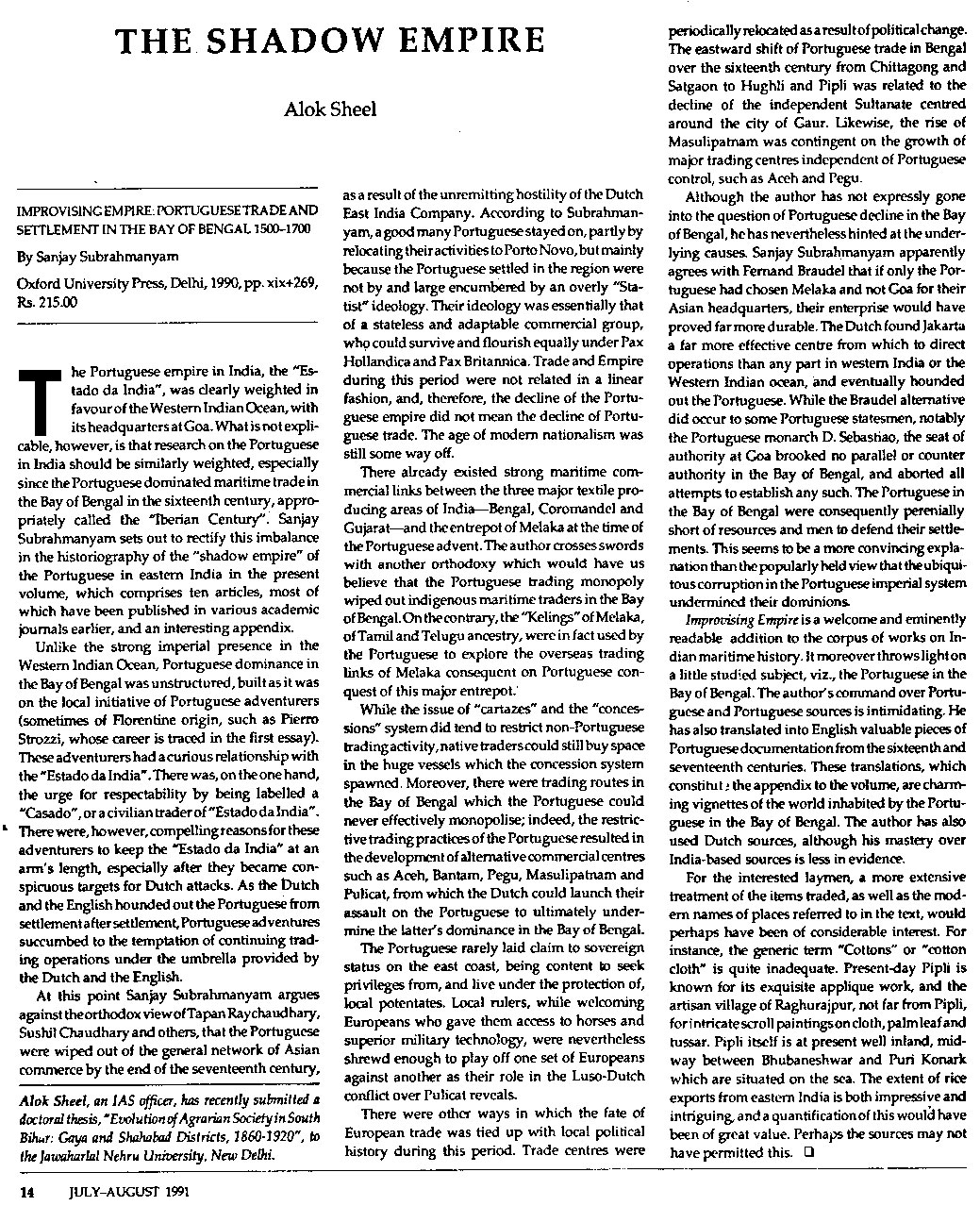
- "The Shadow Empire", Review of Improvising Empire : Portuguese Trade and Settlement in the Bay of Bengal 1500 - 1700, by Sanjay Subrahmanyam, in The Book Review, July - Aug, 1991.
- "Peasantry and Nationalism in Late Colonial India", Studies in History, 2,2, n.s. (1986). Reprinted in Agrarian Structure and Peasant Revolt in India, ed. A.K.Gupta (New Delhi, 1986)
- "Eastern Uttar Pradesh : Inundation and Backwardness", Economic and Political Weekly, 18, No.13, March 26, 1983.
- "Dynamics of Rural Agitation", Review of Peasant Nationalists of Gujarat Kheda District 1917 - 1934 by David Hardiman, in The Book Review, Vol. VI, No.3, Jan-Feb. 1982.
- "Decadence of a Society", Review of Land, Landlords and the British Raj. Northern India in the Nineteenth Century by Thomas R. Metcalf, in The Book Review, Vol. IV, Nos. 5 & 6, March/April & May/June, 1980.
.06
Opinion Pieces
Links to pieces in Economic and Political Weekly
Links to opinion pieces in East Asia Forum
Links to opinion pieces in Mint
Links to opinion pieces in Business Standard
Links to opinion pieces in Indian Express
Links to opinion pieces in Financial Express
Links to comments in Financial Times
All Op-Ed Contributions
- "Brics Bank: Its loan book is too modest for its objectives", Mint, October 13, 2026. (Print version)
- "Democracy: Where Tocqueville, Tagore, and Ambedkar converge", Mint, September 1, 2026. (Print version)
- "Decline of the American Empire?", Mint, February 17, 2026 (Print version)
- "As 2026 dawns, let us ring the bells that can still ring", Mint, December 26, 2025. (Print version)
- "Trade:A tale of the US Grasshopper versus Chinese Ant", Mint, July 11, 2025. (Print version)
- "2025: Whither Democracy?", The India Forum, January 3, 2025. (Print version)
- "A Return to Roots in the New Year", The Wire, December 28, 2024. (Print version)
- "India's response to urban floods needs an in-depth study of causes", Mint, July 11, 2024. (Print version)
- "Two Visions for India", The India Forum, March 25, 2024. (Print version)
- "Old wine in new bottles: Watching the rise of the global far right", The Wire, December 31, 2023. (Print version)
- "Political economy of federalism: contain 'transfer union' discord", Mint, November 28, 2023. (Print version)
- "Assessing the Delhi G 20 Summit", Financial Express, September 11, 2023 (Print version) BBC World Service -Newsday, September 8, 2023
- "What might Tagore and Gandhi be discussing today?", The Wire, August 15, 2023. (Print version)
- "State run versus private armies: Wagner triggered a debate", Mint, July 13, 2023. (Print version)
- "A Brief History of the Radically Different Nationalisms Vying to Shape the Indian Republic", The Wire, June 19, 2023 (Print)
- "Civil society and its role in preventing tyranny", The Wire, May 20, 2023 (Print)
- "Aim for a best-care scenario for catching up with China", Mint, April 13, 2023. (Print version)
- "With geopolitics taking centre-stage, is the G 20 fundamentally changing?:, The Wire, March 10, 2023 (Print)
- "The bar for Delhi"s G 20 Summit may have been set in Bengaluru", Mint, February 28, 2023. (Print version)
- "India's growth story needs deep analysis, not constant trumpeting", Mint, February 6, 2023. (Print version)
- "The civil servant's new Bible: How to cook a dosa", The India Forum, December 20, 2022 (Print)
- "Let the third crisis of capitalism concentrate our minds", Mint, December 15, 2022. (Print version)
- "Climate change negotiations and India's G 20 Presidency", Blitz India, November 14, 2022 (Print version)
- "Global Hunger Rating should shock us into policy review," Mint, October 27, 2022. (Print version)
- "Demagogues, not monarchs, are the threat to democracy", Mint, September 27, 2022. (Print version)
- "Sahir Ludhianvi's song for a 'New India' : Circa 2022", The India Forum, August 2022
- "Our challenge will be sustaining rapid growth after fiscal 2022-23", Mint, June 22, 2022. (Print version)
- "Attempts to right wrongs of the past can't do any good", Mint, May 26, 2022. (Print version)
- "Systems of global government should move beyond realpolitik", Mint, April 5, 2022. (Print version)
- "The swan song of coronavirus is audible in an ebbing third wave", Mint, March 10, 2022. (Print version)
- "Covid-19 21 months after it struck: Is it a replay of the Spanish Flu?", Mint, December 17, 2021. (Print version)
- " A lengthening G-7 shadow over the G20 was apparent in Rome", Mint, November 22, 2021. (Print version)
- "RBI faces monetary policy dilemmas", Mint, October 8, 2021. (online print out)
- "A crisis of multilateralism and Asia's rising stake in it", Mint September 29, 2021 (Print version)
- "Ethnocracy: A darker State", Letters, The India Forum, August 23, 2021. (Print version)
- "Global covid trends suggest the pandemic may be petering out", Mint , July 29, 2021 (Print version)
- "Fiscal policy needs to address triple whammy of inflation, growth, threat of capital outflows", Financial Express, June 19, 2021 (Print version)
- "Global covid trends:The second wave and where we are headed", Mint , June 9, 2021 (Print version)
- "India must watch out for a taper tantrum in global capital markets", Mint , May 24, 2021 (Print version)
- "India's second wave: Deadly but not more than transatlantic's", Financial Express, April 23, 2021 (Print version)
- "The IMF's outdated outlook and our policy challenges", Mint April 9, 2021 (Print version)
- "One Year of Covid-19: A Continuing Pandemic Puzzle", Financial Express, March 9, 2021 (Print version)
- "India's budget 2020-21 and fiscal policy", East Asia Forum, February 10, 2021 (Print Version)
- "How economic management and outcomes differ across the G 20", Mint February 10, 2021 (Print version)
- "Is Covid-19 merely a transatlantic epidemic?", Financial Express, January 25, 2021 (Print version)
- "An apocalyptic year that should give way to a wellspring of hope", Mint December 25, 2020 (Print version)
- "Covid 19 Second Wave: A Winter Surge", Financial Express, December 9, 2020 (Print version)
- "The Post Pandemic G 20 Role in the Global Financial Architecture", Mint November 23, 2020 (Print version)
- "A Fresh Capital Crisis Looms Over India's Banking Sector Mint October 28, 2020 (Print version)
- "Recent Global Covid-19 Trends. The Second Wave?", Financial Express, October 24, 2020 (Print version)
- "The Shape of Economic Recovery", Financial Express, October 3, 2020 (Print version)
- "Fraenkel's theory of the dual State may need an update", Mint September 24, 2020 (Print version)
- "The Covid Axis Shifts to the West Atlantic", Financial Express, September 12, 2020 (Print version) Full spreadsheet
- "Bretton Woods 3 puts the Dollar's Dominance at Risk", Mint September 3, 2020 (Print version)
- "Covid 19: Beginning of the end?", Business Standard, July 27, 2020 (Print version)
- "Will the macroeconomic policy response to Covid-19 be enough?", East Asia Forum, June 13, 2020 (Print Version)
- "The covid crisis could alter the appeal of public ideals", Mint June 11, 2020 (Print version)
- "Breaching the Covid 19 Maginot Line?", Business Standard, June 8, 2020 (Print version)
- "A brief history of pandemics", Financial Express, May 20, 2020 (Print version)
- "In search of the right prescription", Business Standard, May 17, 2020 (Print version)
- "Financial effects of reset in US-China ties", The Hindu Business Line, May 11, 2020 (Print version)
- "The spectre of a new kind of famine haunts India now", Mint, April 30, 2020 (Print version)
- "Lives versus Livelihoods", Business Standard, April 26, 2020 (Print version)
- "The government may be faced with a big dilemma in 2020-21", Mint, February 28, 2020 (Print version)
- "India's 2020 budget falls short of expectations", East Asia Forum, February 25, 2020 (Print Version)
- "The IMF's Growth Downgrade Math", Business Standard, February 10, 2020 (Print version)
- "The long winter that liberal democracy has been staring at", Mint, December 31, 2019 (Print version)
- "Unravelling India's growth story", Business Standard, December 29, 2019 (Print version)
- "The Rise of Counter-revolution", Business Standard, December 1, 2019 (Print version)
- "Growth, Income, Poverty and the Nobel", Business Standard, October 25, 2019 (Print version)
- "The Five Trillion Math", Business Standard, October 20, 2019 (Print version)
- "Enigmas of the Indian Economy", East Asia Forum, September 18, 2019 (Print Version)
- "State of the Economy: Alok Sheel Exclusive", ET Now TV Channel, August 9, 2019.
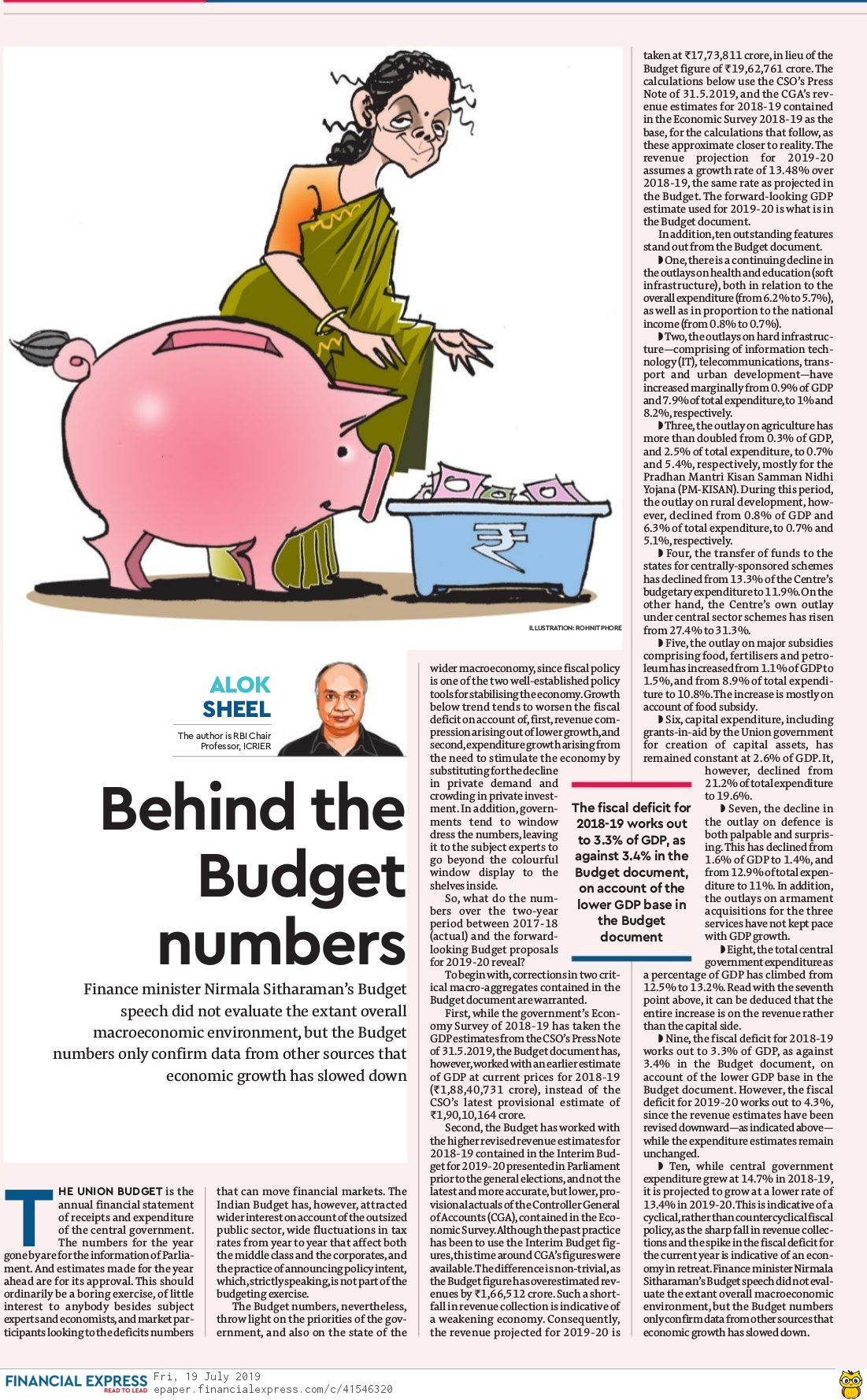
- "Behind the budget numbers", Financial Express, July 19, 2019 (Print version)
- "India's Upcoming G 20 Presidency", Business Standard, July 16, 2019 (Print version)
- "Foreign Currency Borrowings: Open doors, don't get carried away", The Economic Times, July 15, 2019 (Print version)
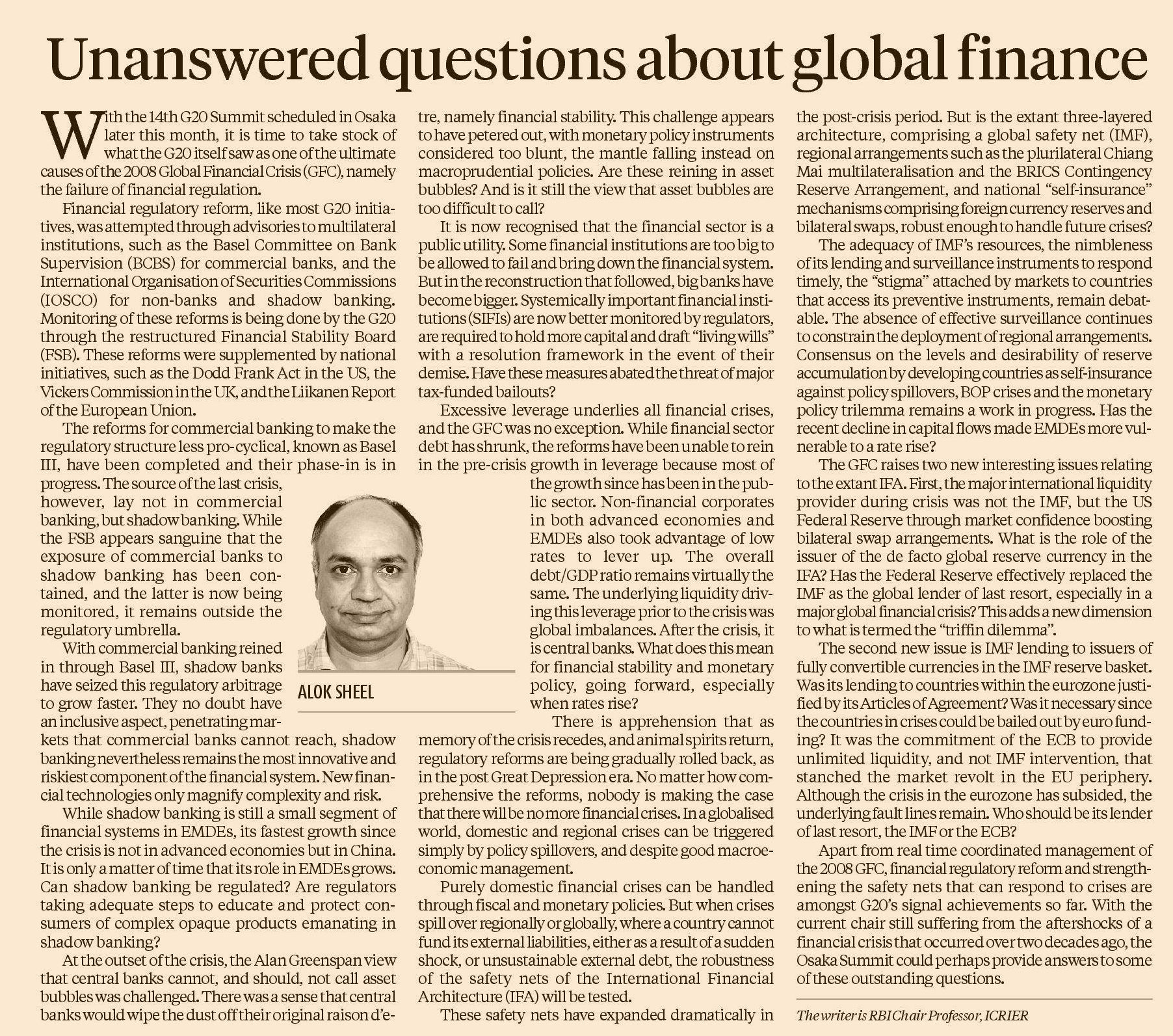
- “Unanswered questions about global finance”, Business Standard, New Delhi, June 4, 2019. (Print version)
- “A Brief History of Time”, Mint, New Delhi, March 09, 2017. (Print version)
- “Is Globalization in Retreat?”, Mint, New Delhi, March 09, 2017. (Print version)
- “Liberalism at the Crossroads”, Mint, New Delhi, February 09, 2017. (Print version)
- “Demonetisation and Monetary Policy”, Mint, New Delhi, January 12, 2017. (Print version)
- “A blunt instrument of economic policy”, Mint, New Delhi, December 8, 2016. (Print version)
- “ Is the history of the 1930s repeating itself”, Mint, New Delhi, November 10, 2016. (Print version)
- “The Reserve Bank of India’s Neutral Rate of Interest”, Mint, New Delhi, October 13, 2016. (Print version)
- “Financial Repression Redux”, Mint, New Delhi, September 8, 2016. (Print version)
- “Floodplains and Flash Floods”, Mint, New Delhi, August 11, 2016. (Print version)
- “The Future of our Economy”, Mint, New Delhi, July 14, 2016. (Print version)
- “Golden Rules of Investment and Debt”, Mint, New Delhi, June 9, 2016. (Print version)
- “Managing India’s Freshwater”, Mint, New Delhi, May 12, 2016. (Print version)
- “Wealth, Happiness and Liberty”, Mint, New Delhi, April 14, 2016. (Print version)
- “India in the Global Economy”, Mint, New Delhi, March 10, 2016. (Print version)
- “The Mechanics of Central Banking”, Mint, New Delhi, February 11, 2016. (Print version)
- "Liberty and the Nation State", Mint, New Delhi, January 14, 2016. (Print version)
- “The Economics of Demographic Shifts”, Mint, New Delhi, December 10, 2015. (Print version)
- “The Crisis in Global Governance”, Mint, New Delhi, November 11, 2015. (Print version)
- “Deconstructing Corruption in India”, Mint, New Delhi, October 15, 2015. (Print version)
- “RBI and the Crisis of Central Banking,” Business Standard, New Delhi, September 28, 2015. (Print version)
- “Seven Years of Global Financial Crisis”, Mint, New Delhi, September 10, 2015. (Print version)
- “Coping with Global Headwinds”, Mint, New Delhi, August 12, 2015. (Print version)
- “India still needs to enter the market for reform”, East Asia Forum, July 12, 2015 (PDF)
- “After the Greferendum”, The Indian Express, New Delhi, July 8, 2015. (Print version)
- “The Blunting of Macroeconomic Policy Tools”, Mint, New Delhi, July 08, 2015. (Print version)
- “The Grexit Fallout”, Financial Express, New Delhi, July 7, 2015. (Print version)
- “Will Modi’s Arrows Hit the Mark?”, East Asia Forum, June 23, 2015. (PDF)
- “An Economics to Fit the Facts?”, Mint, New Delhi, June 10, 2015. (Print version)
- “Wanted: Productivity Fuelled Growth”, Mint, New Delhi, May 13, 2015. (Print version)
- “Indian Economy: To Plan or Not to Plan”, Mint, New Delhi, April 8, 2015. (Print version)
- “The Test of a Good Budget”, Mint, New Delhi, March 11, 2015. (Print version)
- “Beyond the New Growth Estimates”, Mint, New Delhi, February 11, 2015. (Print version)
- “Housing and Financial Stability”, Mint, New Delhi, January 16, 2015. (Print version)
- “Frozen in Time: World Bank, IMF”, Mint, New Delhi, December 15, 2014 (Print version)
- “Less growth, more time for leisure, family and friends?”, Financial Times, London, October 17, 2014 (Print version)
- “The Great Stagnation and the G 20”, Mint, New Delhi, September 26, 2014 (Print version)
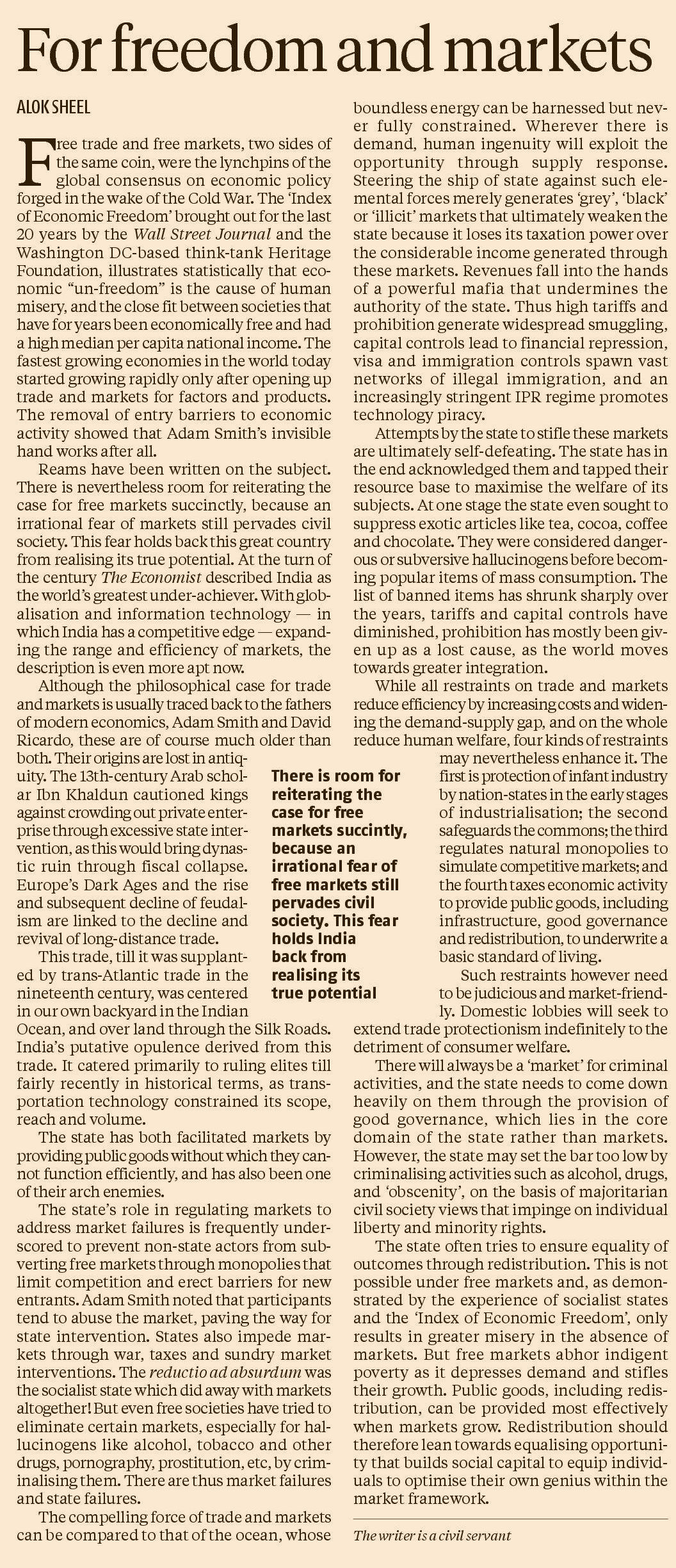
- “For Freedom and Markets”, Business Standard, New Delhi, August 24, 2014. (Print version)
- “Re-booting the G 20 Framework”, Business Standard, New Delhi, July 24, 2014. (Print version)
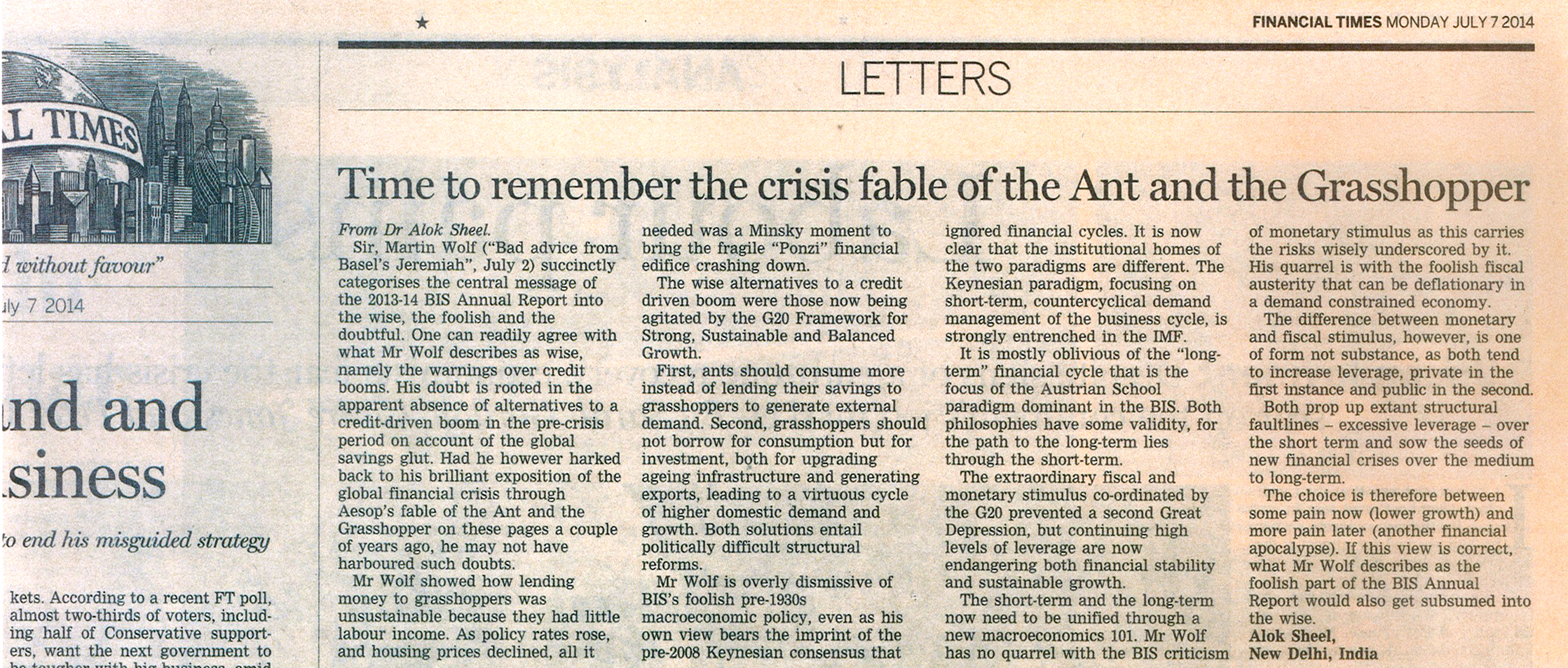
- “Time to remember the crisis fable of the Ant and the Grasshopper”, Financial Times, London, July 7, 2014 (Print version)
- “Financial Regulatory Reform: The Emerging Market Perspective”, Financial Express, New Delhi, June 13, 2014. (Print version)
- “Financial Regulatory Reform: A Mid-term Reality Check”, Financial Express, New Delhi, June 12, 2014. (Print version)
- “What it Takes for an Economic Turnaround”, The Indian Express, New Delhi, May, 19, 2014. (Print version)
- “Inflation Control Dynamics”, Financial Express, New Delhi, May 16, 2014. (Print version)
- “Pause and Reframe”, The Indian Express, New Delhi, March 24, 2014. (Print version)
- “India’s Three Arrows – How it Can Fire Itself Back to High Growth”, Business Standard, New Delhi, March 2, 2014 (Print version)
- “When Rates Don’t Matter”, The Economic Times, New Delhi, February 27, 2014 (Print version) erratum
- “The Dollar Drag”, Financial Express, New Delhi, February 7, 2014. (Print version)
- “How Emerging Markets Deal with Global Spill Overs”, Business Standard, New Delhi, January 26, 2014 (Print version)
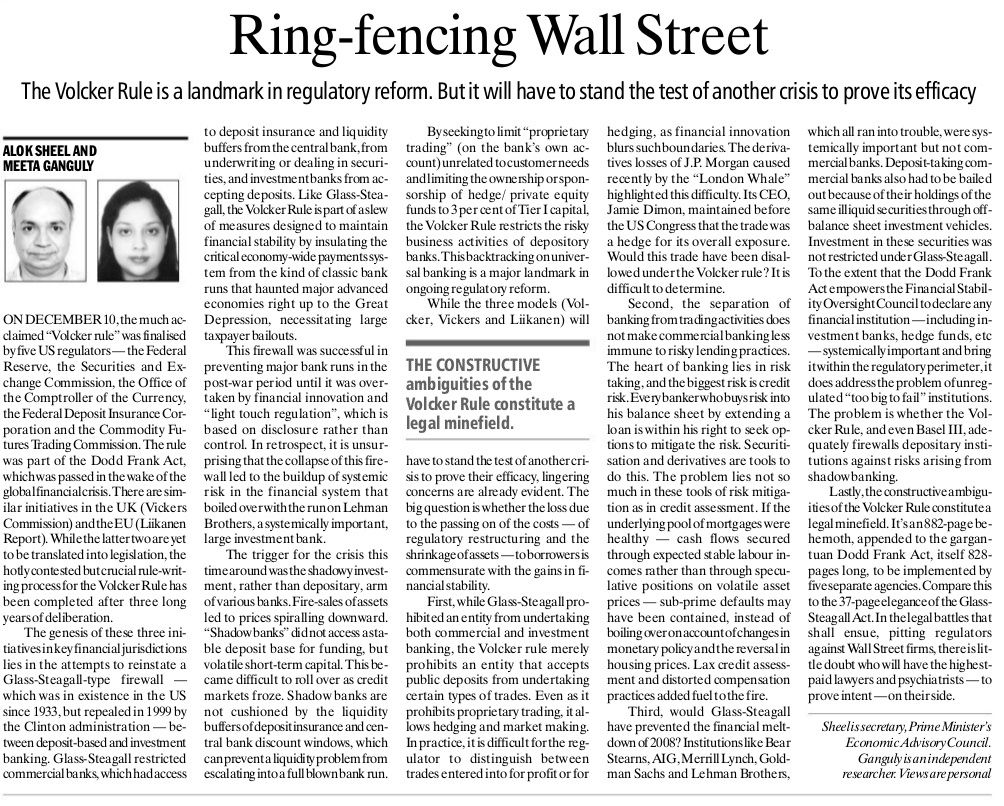
- “Ring-fencing Wall Street”, (with Meeta Ganguly), The Indian Express, New Delhi, December 23, 2013. (Print version)
- “Resurgence and Limitations of Keynesianism”, (with C.Rangarajan), Financial Express, October 23, 2013. (Print version)
- “Different Strokes” The Indian Express, New Delhi, September 30, 2013. (Print version)
- “St Petersburg G 20 Summit: Unintended Consequences”, Business Standard, New Delhi, September 11, 2013 (Print version)
- “EMEs at St Petersburg: Emerging Issues”, The Financial Express, New Delhi, August 23, 2013 (Print version)
- “EMEs at St Petersburg: Petering Out”, The Financial Express, New Delhi, August 22, 2013 (Print version)
- “What Ben Bernanke Didn’t Say”, Business Standard, New Delhi, August 5, 2013 (Print version)
- “India’s External Sector: The Ghosts of 1991”, Business Standard, New Delhi, July 21, 2013 (Print version)
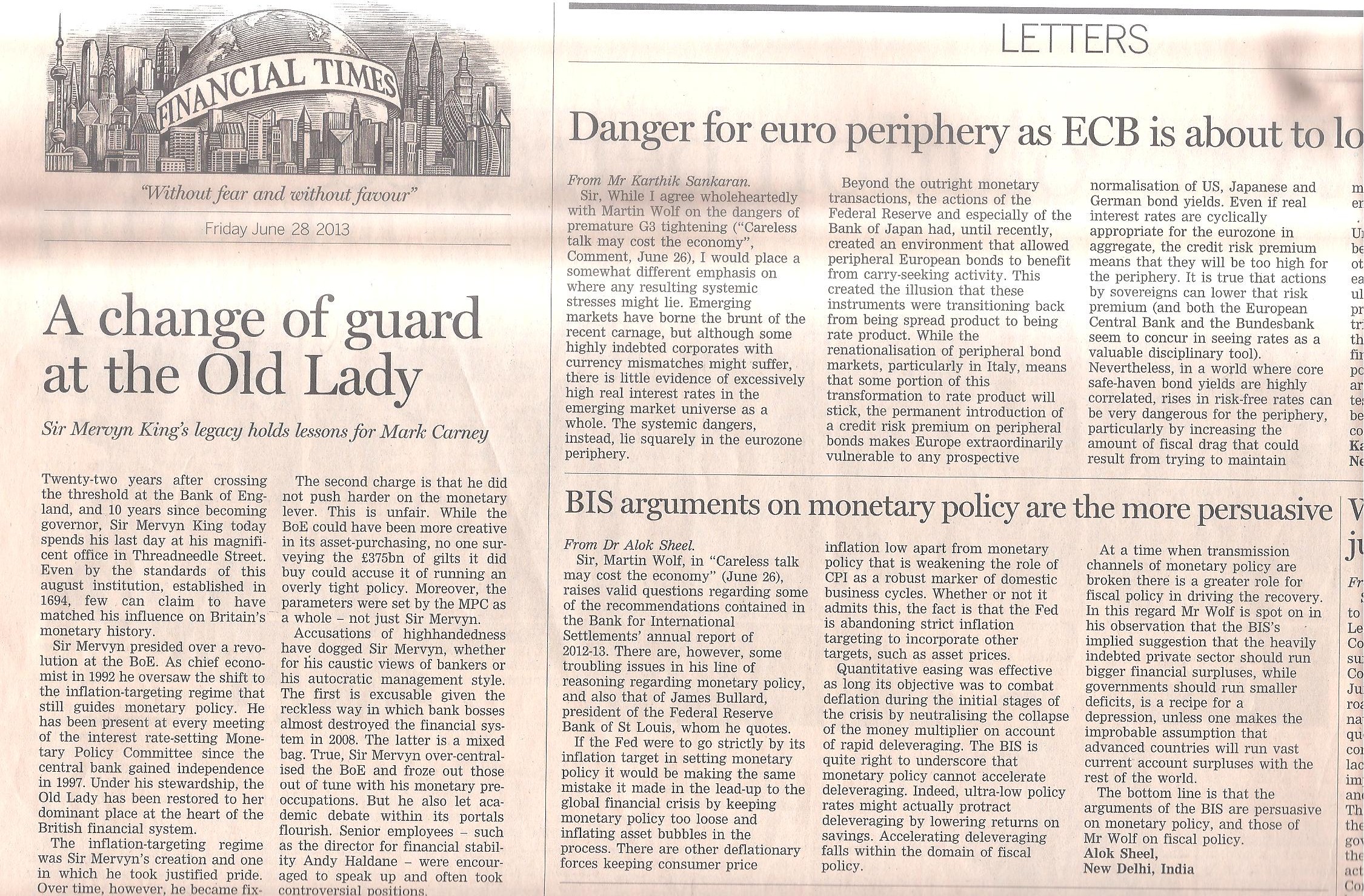
- “BIS arguments on monetary policy are the more persuasive”, Financial Times, London, June 28, 2013 (Print version)
- “Why the IMF May Be Wrong on Inflation Targeting”, Business Standard, New Delhi, June 24, 2013 (Print version)
- “How Risk Free is Domestic Sovereign Debt?”, Business Standard, New Delhi, June 10, 2013 (Print version)
- “R&R Hit: How Much Debt is Cool Enough.” The Economic Times, New Delhi, May 17, 2013 (Print version)
- “Drivers of the Gold Boom, Bust, and….” Business Standard, New Delhi, April 29, 2013 (Print version)
- “Misunderstood dog has not barked, yet”, Financial Times, London, April 19, 2013 (Print version)
- “The Central Banker’s Brahmastra”, Business Standard, New Delhi, April 2, 2013 (Print version)
- “Building BRICS Without Straw”, The Financial Express, New Delhi, April 1, 2013 (Print version)
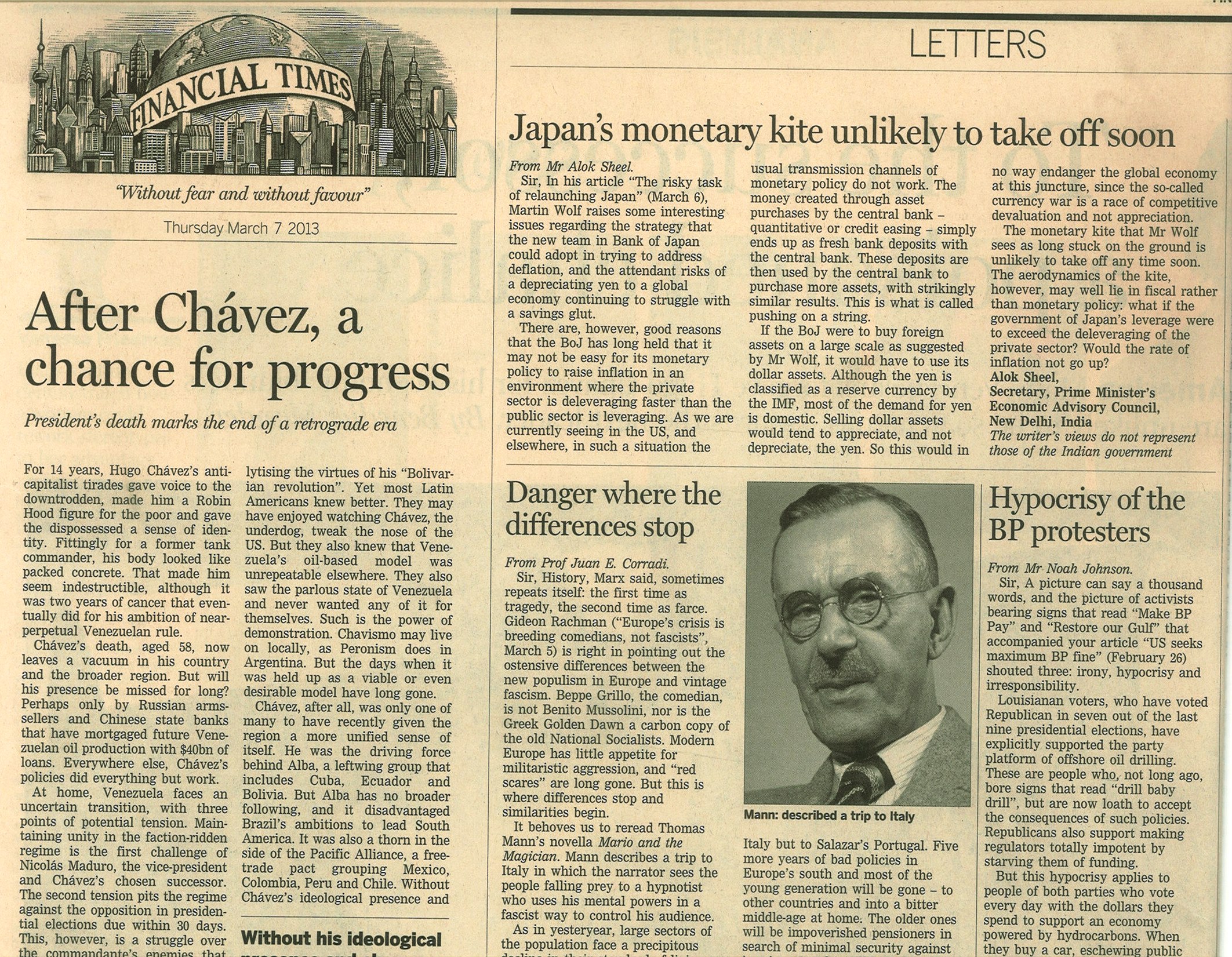
- “Japan’s Monetary Kite Unlikely to Take Off Soon”, Financial Times, London, March 7, 2013 (Print version)
- “Growth Now, Need for Austerity Next”, Business Standard, New Delhi, February 22, 2013 (Print version)
- “The Global Financial Crisis on its Sixth Birthday”, The Economic Times, New Delhi, January 21, 2013, 2012 (Print version)
- “A Road Map for the Austerity – Growth Policy Dilemma” (with C.Rangarajan) Business Standard, New Delhi, January 7, 2013 (Print version)
- Reflections on Recent Indian and Chinese Growth, The Economic Times, New Delhi, November 26, 2012 (Print version)
- “BASEL III Not Suited for Emerging World Banking”, The Economic Times, New Delhi, September 24, 2012 (Print version)
- “The Surprises of Los Cabos”, Business Standard, New Delhi, July 1, 2012 (Print version)
- “New Lows at Los Cabos?”, Business Standard, New Delhi, June 9, 2012 (Print version)
- “G20 and a New Political Economy of Globalization”, The Economic Times, New Delhi, May 21, 2012 (Print version)
- “Waiting for ECB, and ‘Big Bertha’”, Business Standard, New Delhi, May 6, 2012 (Print version)
- “Ben Bernanke, the Great Innovator” Business Standard, New Delhi, February 19, 2012 (Print version)
- “Flawed Signals from Cannes”, Business Standard, New Delhi, December 10, 2011 (Print version)
- “Eurozone’s Impossible Trinity”, Business Standard, New Delhi, November 24, 2011 (Print version)
- “India and Europe: drivers of the new paradigm”, The Financial Express, New Delhi, November 4,2011 (Print version)
- “India and Europe : time for a paradigm shift?”, The Financial Express, New Delhi, November 3, 2011 (Print version)
- “It’s a Long Road from Keynes to Cannes”, Business Standard, New Delhi, October 30, 2011 (Print version)
- “Wealth and Well-being”, Business Standard, New Delhi, October 6, 2011 (Print version)
- “Migration, Growth and the Human Future”, The Economic Times, New Delhi, September 26, 2011 (Print version)
- “The Rise and Decline of Fiat Money?”, Business Standard, New Delhi, August 29, 2011 (Print version)
- “Regulatory Change At Risk” The Economic Times, New Delhi, August 4, 2011 (Print version)
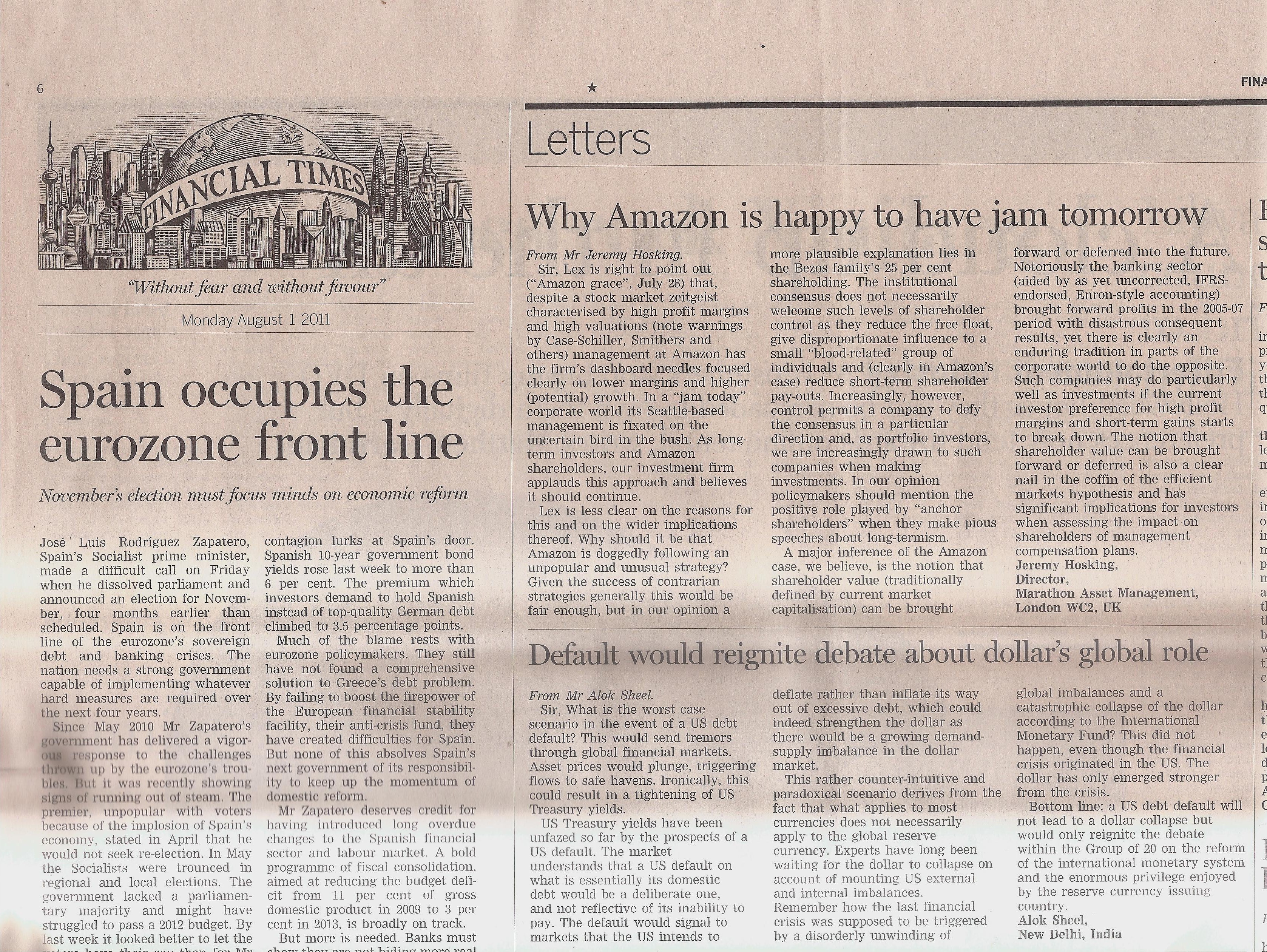
- “Default would re-ignite debate about Dollar’s global role”, Financial Times, London, August 1, 2011 (Print version)
- “Quantitative Easing and the Great Recession”, Business Standard, New Delhi, May 30, 2011 (Print version)
- “The Unfinished Business of Global Rebalancing”, Business Standard, New Delhi, February 13, 2011 (Print version)
- “Infrastructure and Global Demand Rebalancing”, The Economic Times, New Delhi, January 31, 2011 (Print version)
- “Seoul-searching in G20”, Business Standard, New Delhi, September 25, 2010 (Print version)
- “Fiscal Paradoxes” Business Standard, New Delhi, July 1, 2010 (Print version)
- “Rules, Regulations, User Charges and Taxes”, The Economic Times, New Delhi, May 27, 2010 (Print version)
- “New Role for Fiscal Policy?” Business Standard, New Delhi, April 27, 2010 (Print version)
- “Cowry Shells to Helicopter Ben”, The Economic Times, New Delhi, March 30, 2010 (Print version)
- “ Global Financial Crisis and Economic Policy”, Business Standard, New Delhi, February, 28, 2010 (Print version)
- “Asia:The Aftermath of Crisis”, The Economic Times, New Delhi, January 18, 2010 (Print version)
- “Revisiting Cross-Border Capital Flows”, Business Standard Weekend, New Delhi, October 17, 2009 (Print version)
- “On a Self-Destructive Mission", Business Standard, New Delhi, August 16, 2009 (Print version)
- “The Other Moore’s Law” , The Economic Times, New Delhi, June 29, 2009 (Print version)
- “Of Economists and Historians”, Business Standard, New Delhi, June 13, 2009 (Print version)
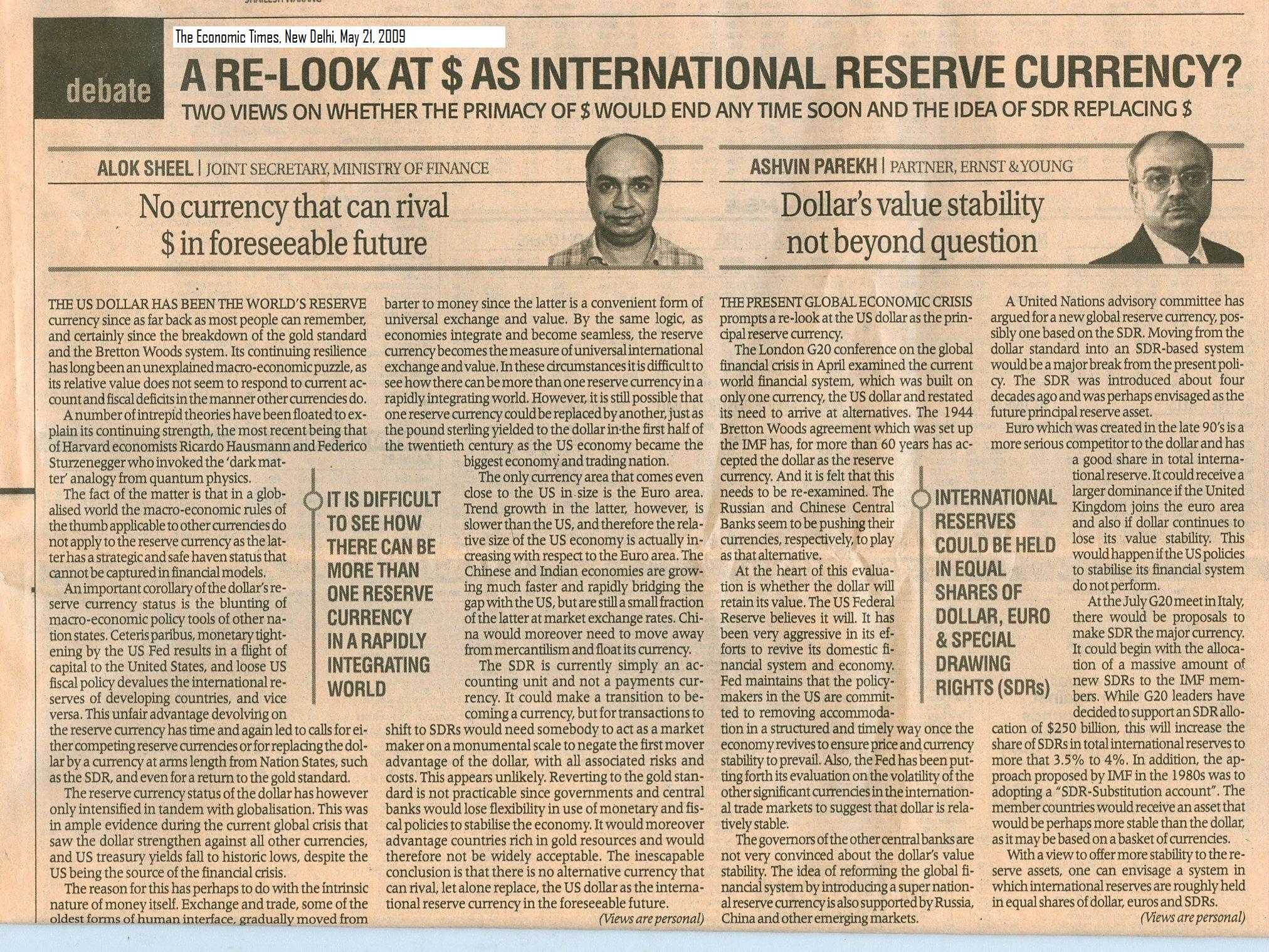
- “A Re-look at Dollar as the International Reserve Currency?”, ET Debates, The Economic Times, New Delhi, May 21, 2009.(Print version)
- “Lessons and Red Herrings”, The Financial Express, New Delhi, April 27, 2009 (Print version)
- “The Future of Globalization”, The Economic Times, New Delhi, February 9, 2009 (Print version)
- "Contrasting Allies", The Economic Times, New Delhi, October 17, 2008.(Print version)
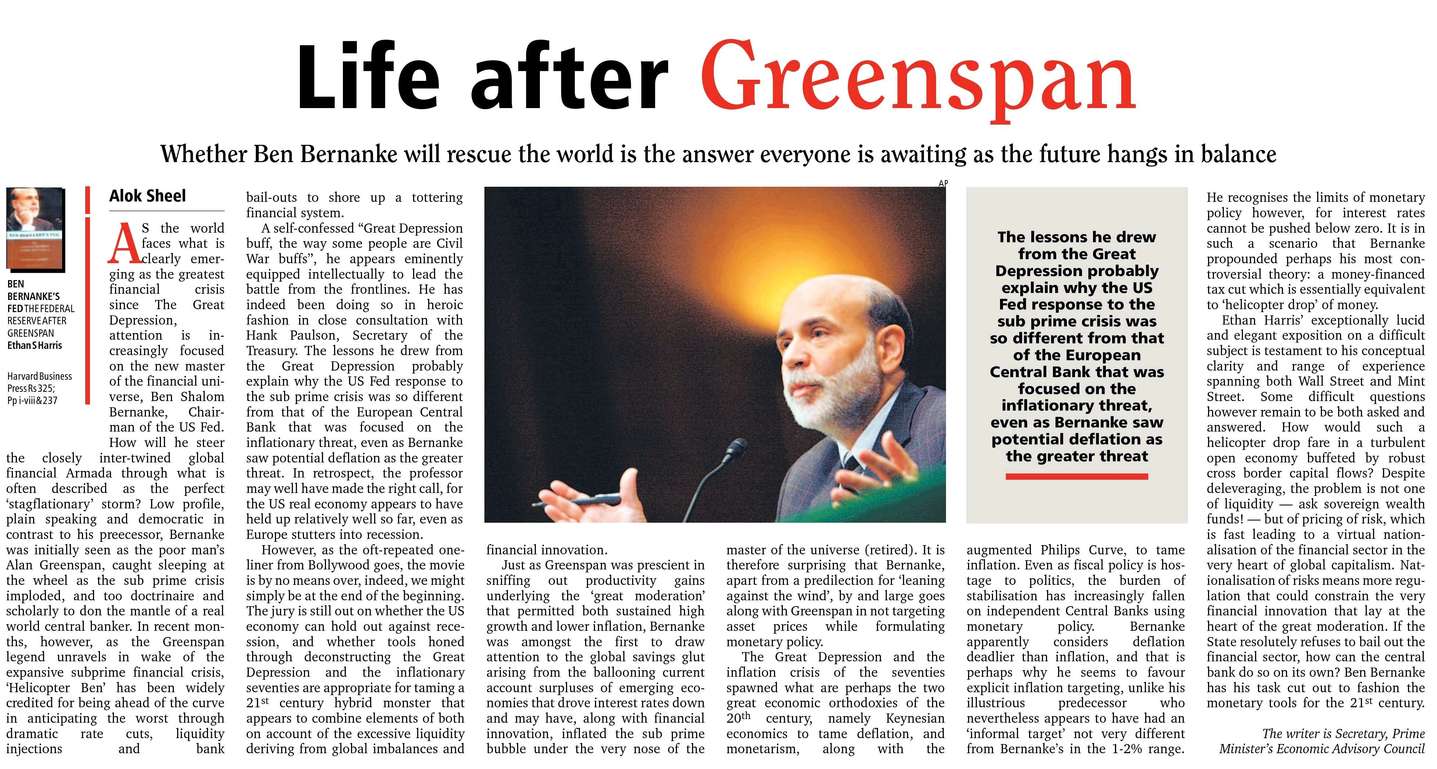
- “Life After Greenspan”, The Financial Express, New Delhi, October 5, 2008 (Print version)
- “Sub Prime Impact on India” Business Standard, New Delhi, September 23, 2008 (Print version)
- "The Left End of History" The Economic Times, New Delhi, September 15, 2008.(Print version)
- "Caught The Second Time Around", Business Standard, New Delhi, August 17, 2008 (Print version)
- “A Brief History of Globalization”, The Economic Times, New Delhi, July 25, 2008.(Print version)
- "What Inflation Targeting?", Business Standard, New Delhi, July 9, 2008 (Print version)
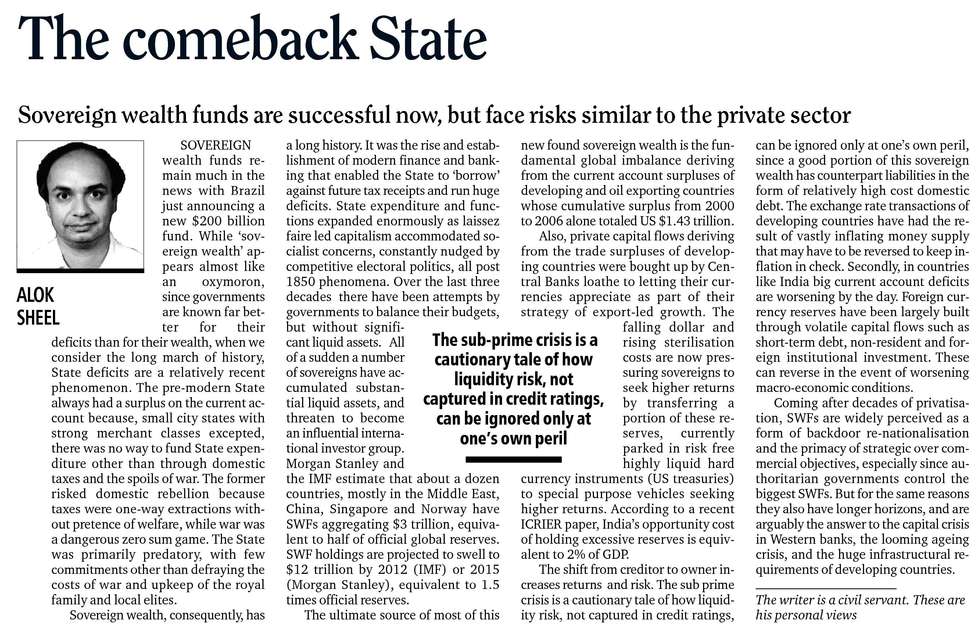
- "The Comeback State", The Financial Express, New Delhi, June 11, 2008 (Print version)
- “The Industrious Revolution and Indian Agriculture”, The Economic Times, New Delhi, June 2, 2008 (Print version)
- "A Brief History of Inflation", Business Standard, New Delhi, May 25,2008 (Print version)
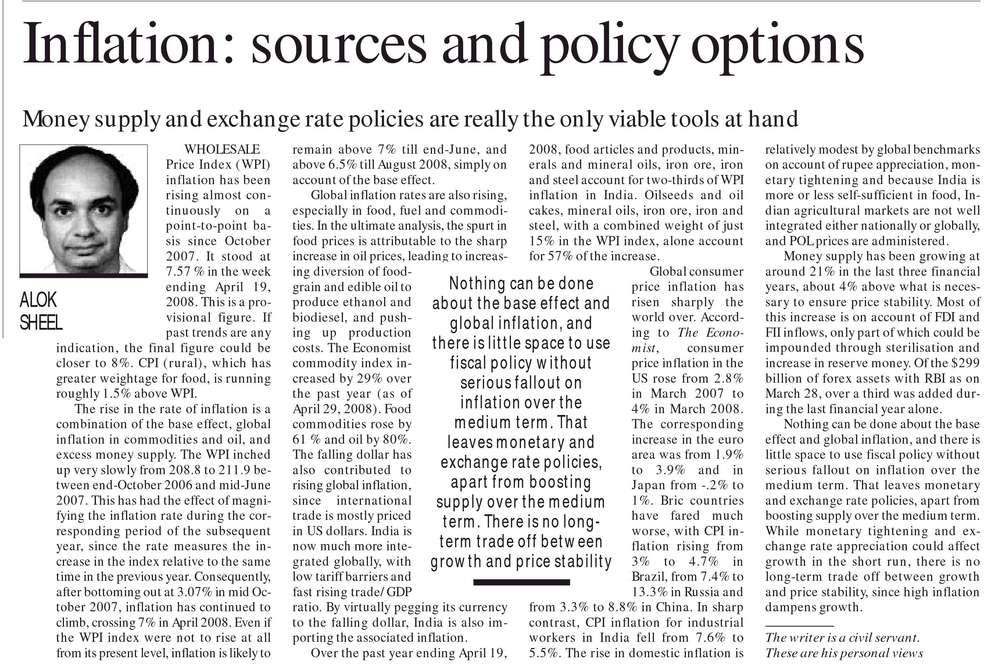
- " Inflation: Sources and Policy Options ", The Financial Express, New Delhi, May 9, 2008 (Print version)
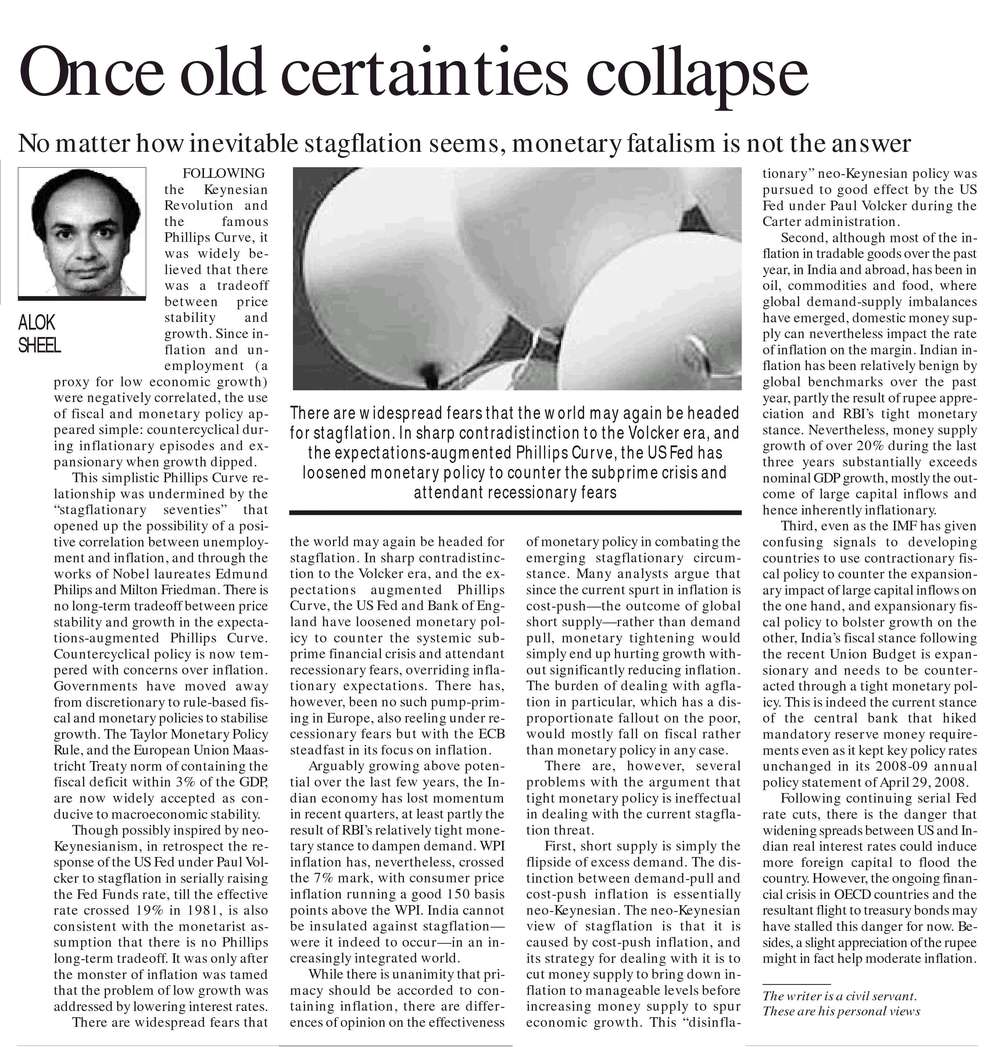
- "Once Old Certainties Collapse", The Financial Express, New Delhi, May 1, 2008 (Print version)
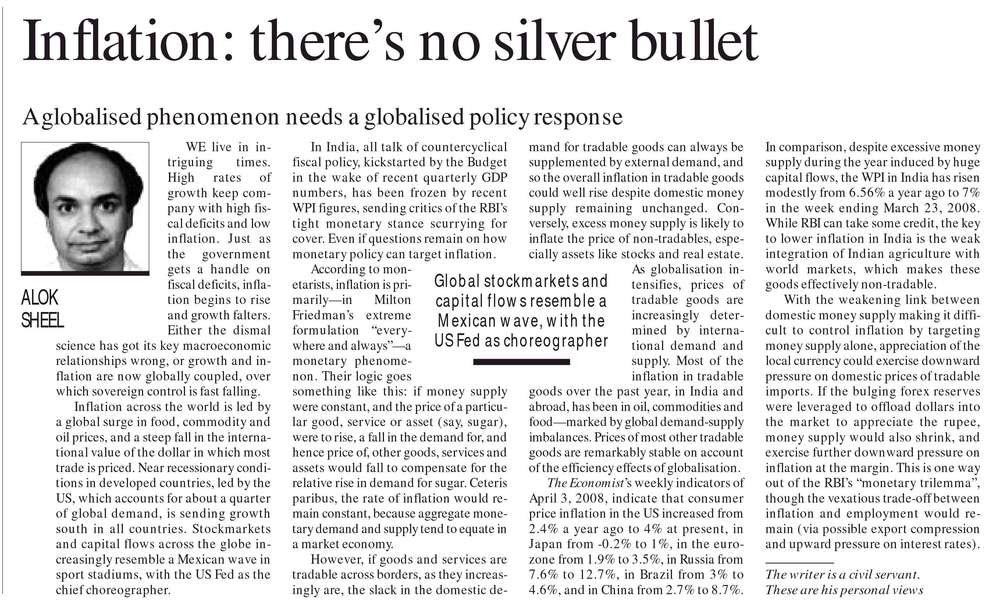
- "Inflation: There's No Silver Bullet", The Financial Express, New Delhi, April 8, 2008 (Print version)
- "Petrodollars Ahoy!", Business Standard, New Delhi, April 6, 2008 (Print version)
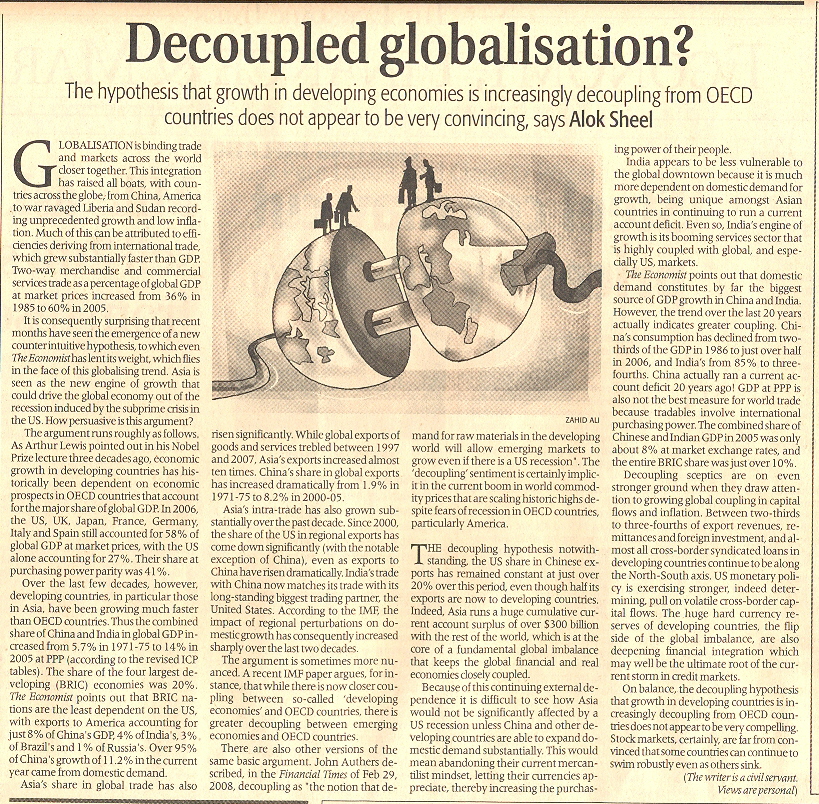
- “Decoupled Globalization?”, The Economic Times, New Delhi, April 2, 2008 (Print version)
- “Inflation As A Tradable Commodity”, The Financial Express, New Delhi, March 12, 2008 (Print version)
- "The Microfinance Conundrum", The Financial Express, New Delhi, February 23, 2008 (Print version)
- "Restructuring Structured Finance", The Economic Times, New Delhi, February 18,2008 (Print version)
- "Inflation in a Globalizing World", The Financial Express, New Delhi, February 13, 2008 (Print version)
- "Macroeconomics of Agflation", The Financial Express, New Delhi, January 16, 2008 (Print version)
- "Fiscal Policy to Rupee's Rescue?", The Economic Times, New Delhi, January 1, 2008,(Print version)
- “An Indian Path to Modernity?” ,The Financial Express, New Delhi, December 19, 2007 (Print version)
- "Unwinding of Global Imbalances?", The Economic Times, New Delhi, December 3, 2007 (Print version)
- “The Failure of Currency Floats” ,The Financial Express, New Delhi, November 21, 2007 (Print version)
- “Constraining Labour Gains” (co-author Sean Dougherty, OECD), Business Standard, New Delhi, October 28, 2007 (Print version)
- “Productivity and Inclusive Growth”, The Financial Express, New Delhi, October 26, 2007 (Print version)
- “Sub Prime, Leverage and Contagion”, The Financial Express, New Delhi, September 26, 2007 (Print version)
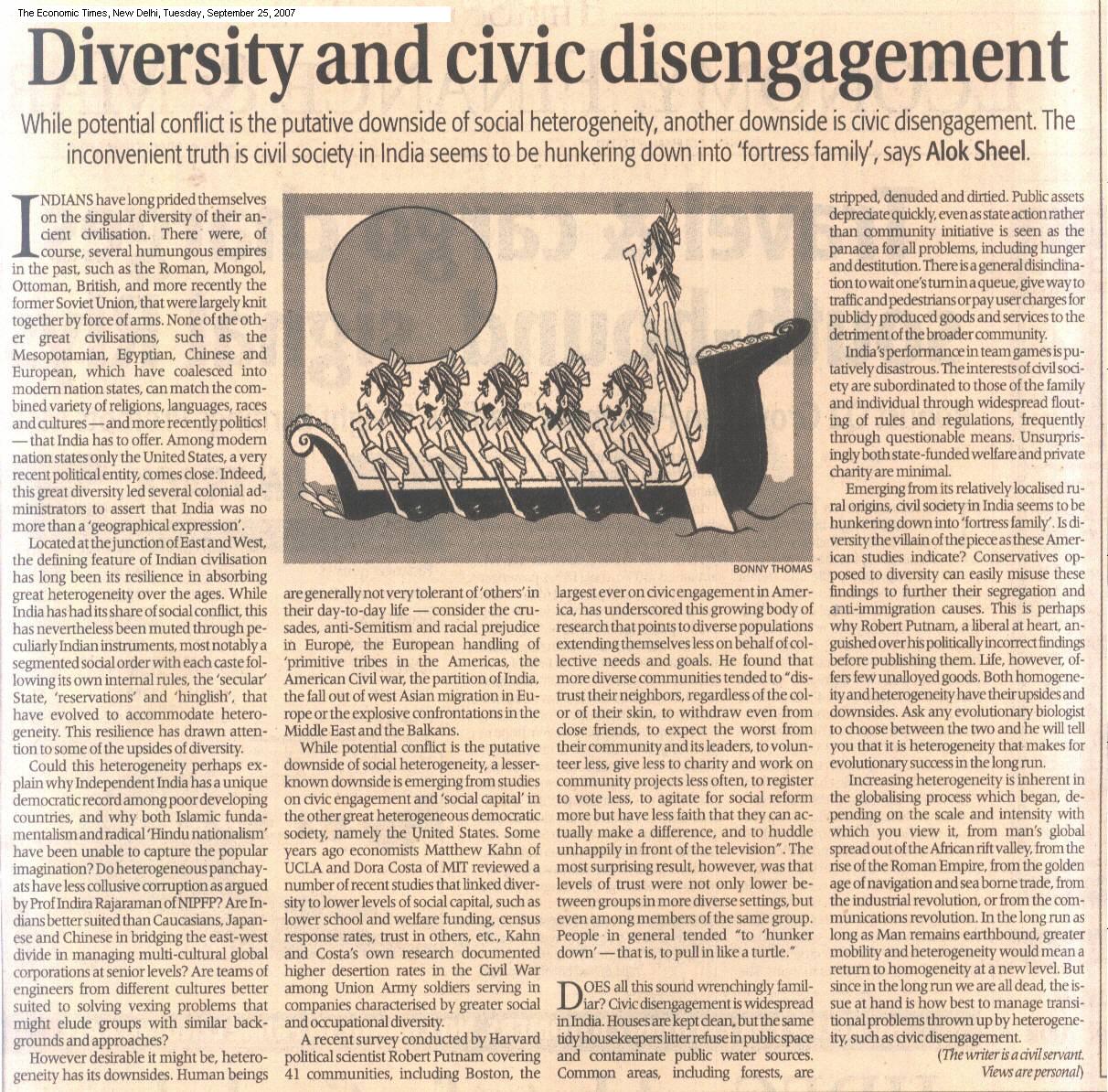
- “Diversity and Civic Disengagement”, The Economic Times, New Delhi, September 25, 2007 (Print version)
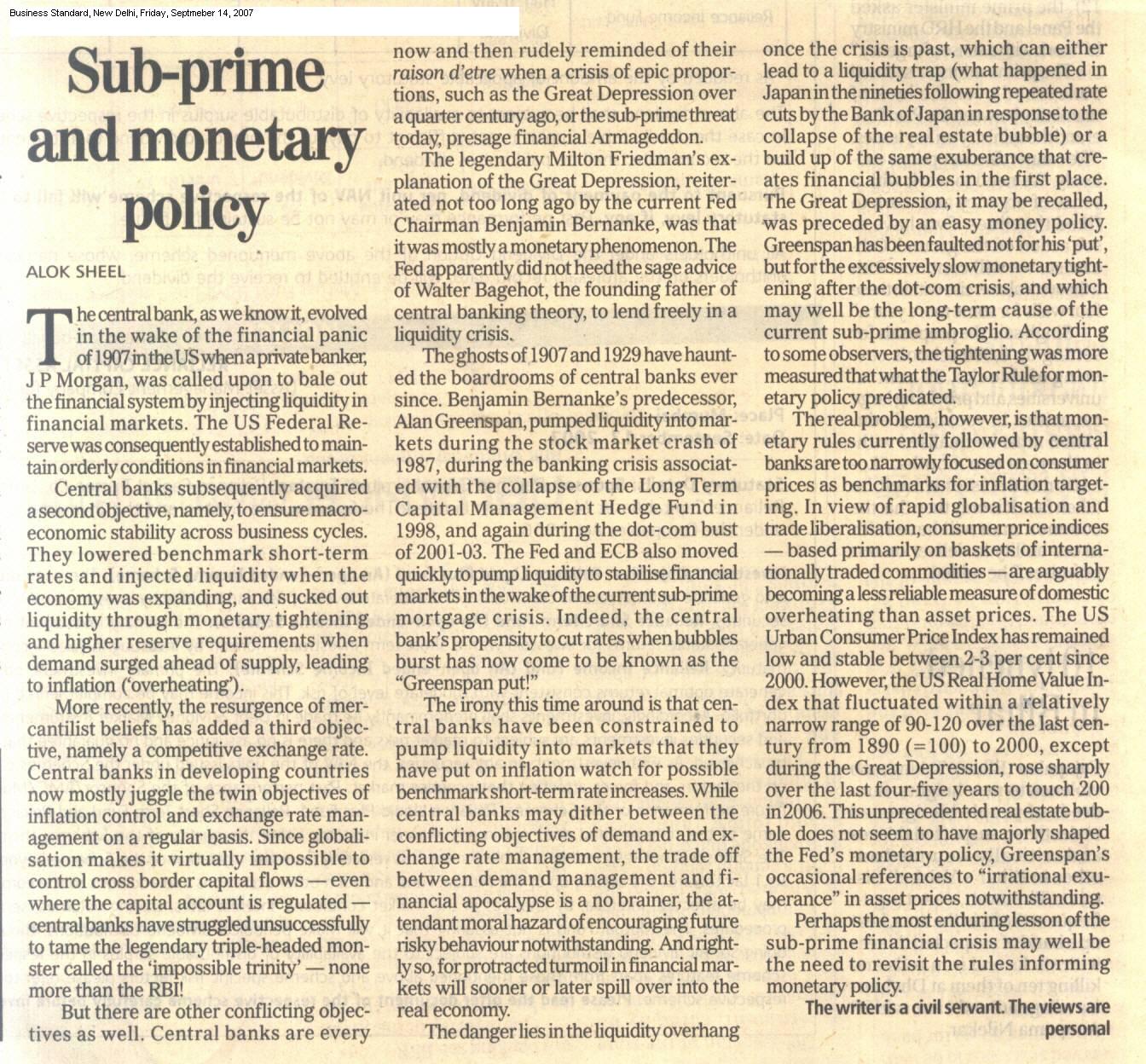
- “Sub Prime and Monetary Policy”, Business Standard, New Delhi, September 14, 2007 (Print version)
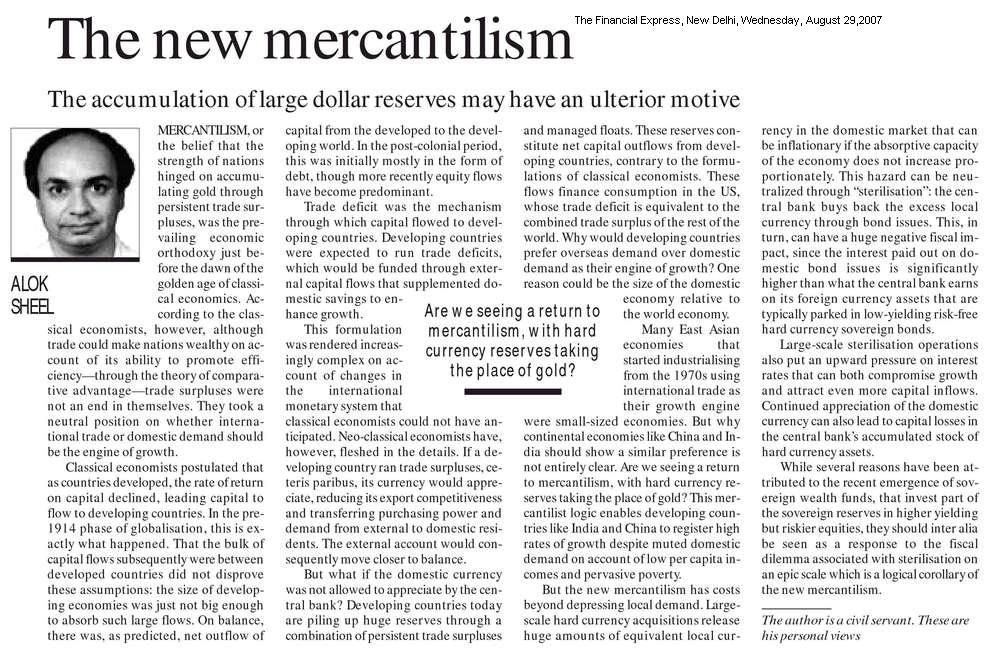
- “The New Mercantilism”, The Financial Express, New Delhi, August 29, 2007 (Print Version)
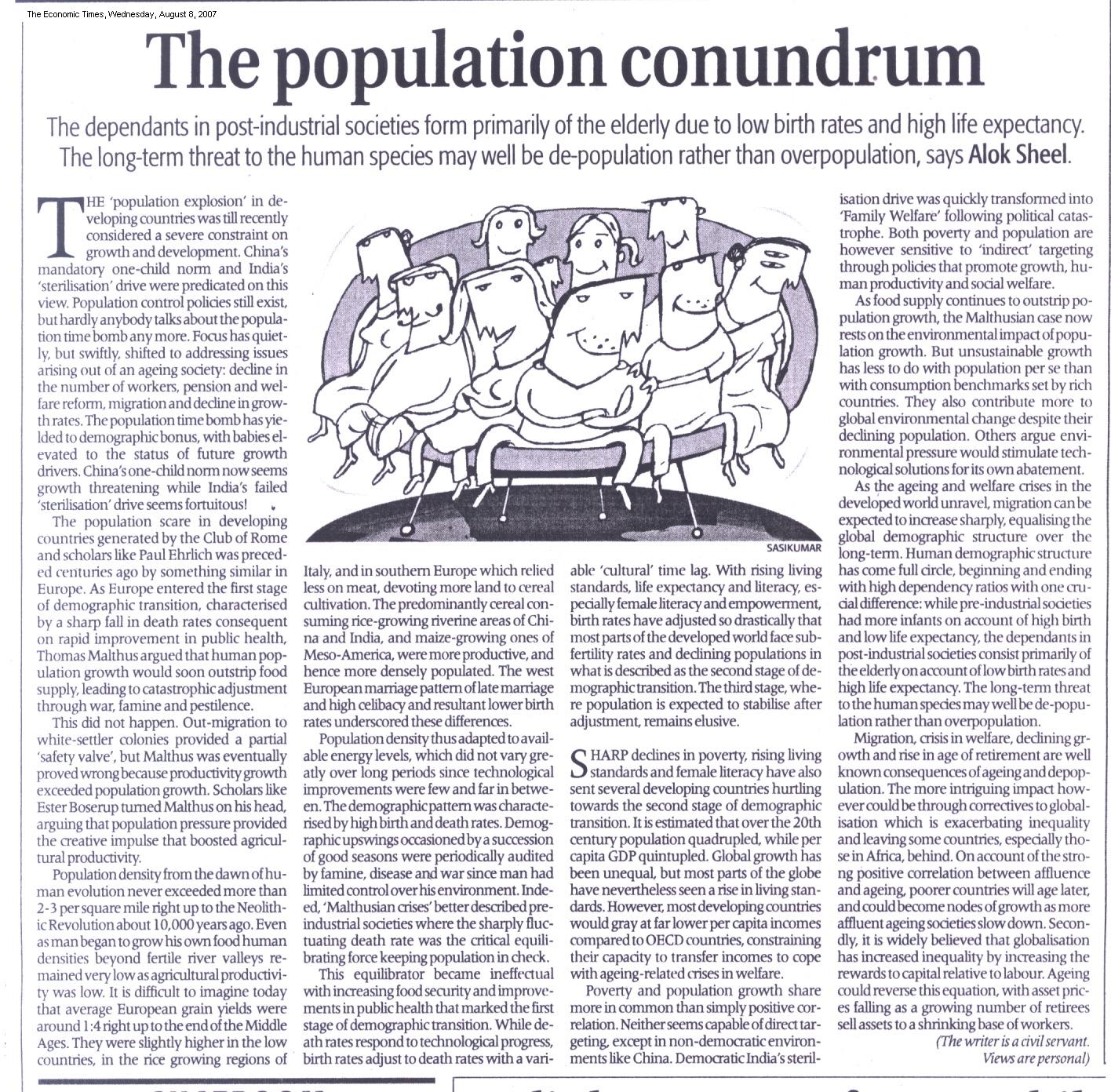
- "The Population Conundrum", The Economic Times, New Delhi, August 8, 2007 (Print version)
- “Leveraged Buy-outs in Aluminum”, The Financial Express, New Delhi, August 1, 2007 (Print Version)
- “History and the Civil Servant”, The Financial Express, New Delhi, July 4, 2007 (Print Version)
- "Digital Barbarians at the Gate?", The Economic Times, New Delhi, June 25, 2007 (Print version)
- “Democratic Chamber Music”, The Financial Express, New Delhi, June 6, 2007 (Print Version)
- “Structural Shifts in India’s Balance of Payments” The Economic Times, New Delhi, May 29, 2007 (Print version)
- “The Emerging Structural Metal Empires”, Business Standard, New Delhi, May 15, 2007 (Print version)
- “A Question of Closing the Gap”, The Financial Express, New Delhi, May 9, 2007 (Print Version)
- “Inequality and the Nation State”, Business Standard, New Delhi, April 29, 2007 (Print version)
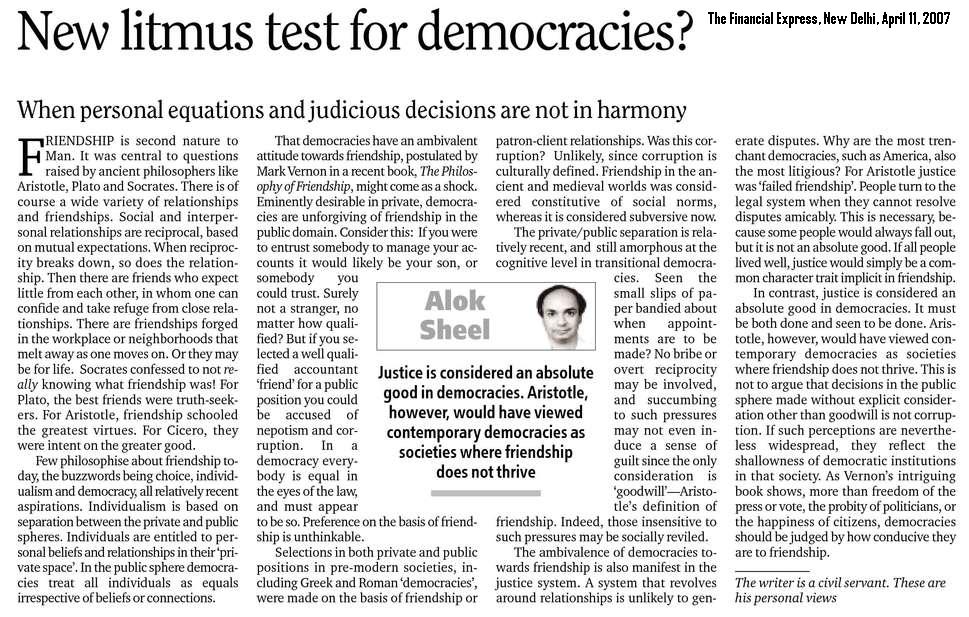
- “New Litmus Test for Democracies?”, The Financial Express, New Delhi, April 11, 2007 (Print Version)
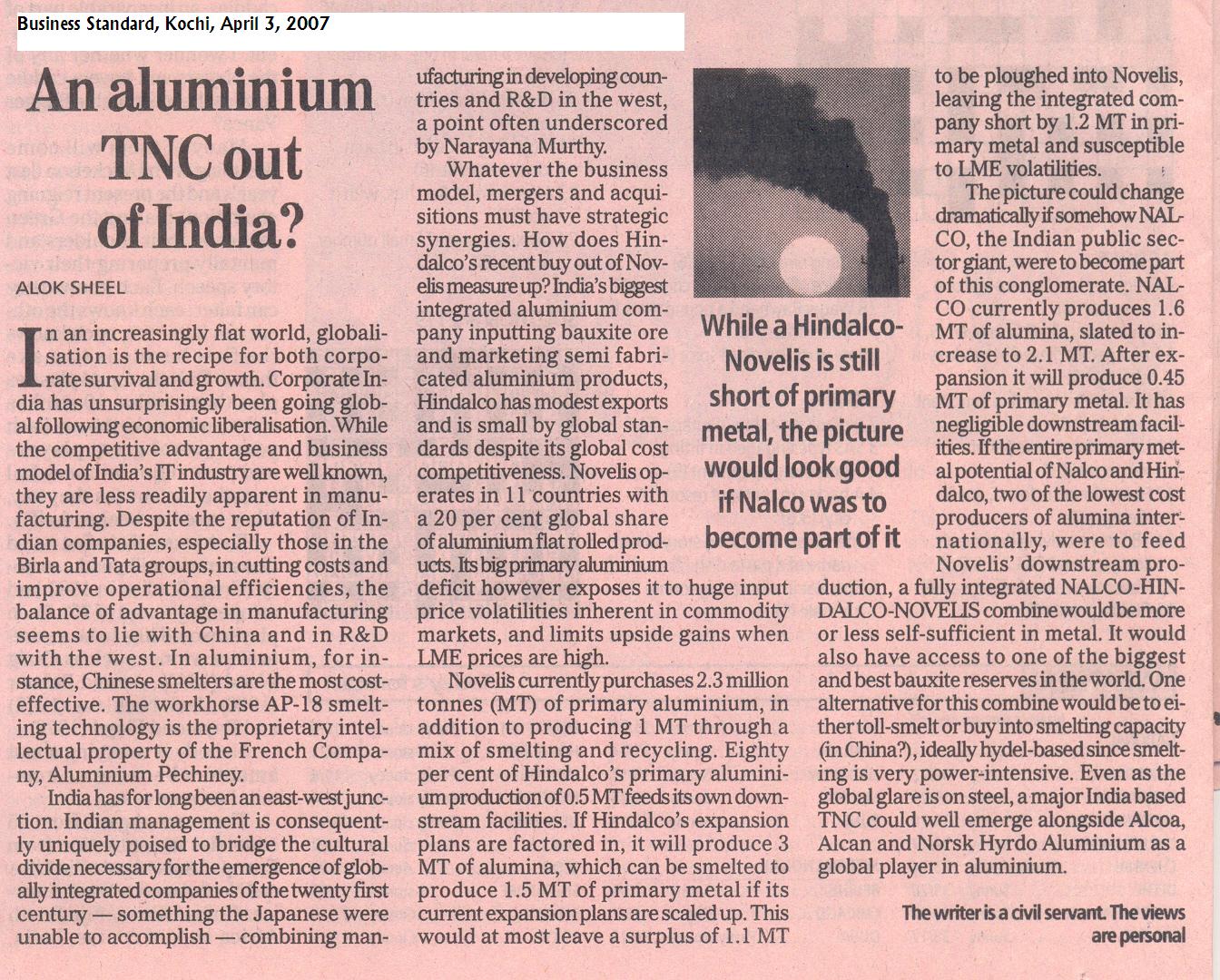
- “An Aluminum TNC out of India? , Business Standard, New Delhi, April 3, 2007 (Print version)
- “Putting Indian Growth in Perspective”, The Economic Times, New Delhi, March 20, 2007 (Print version)
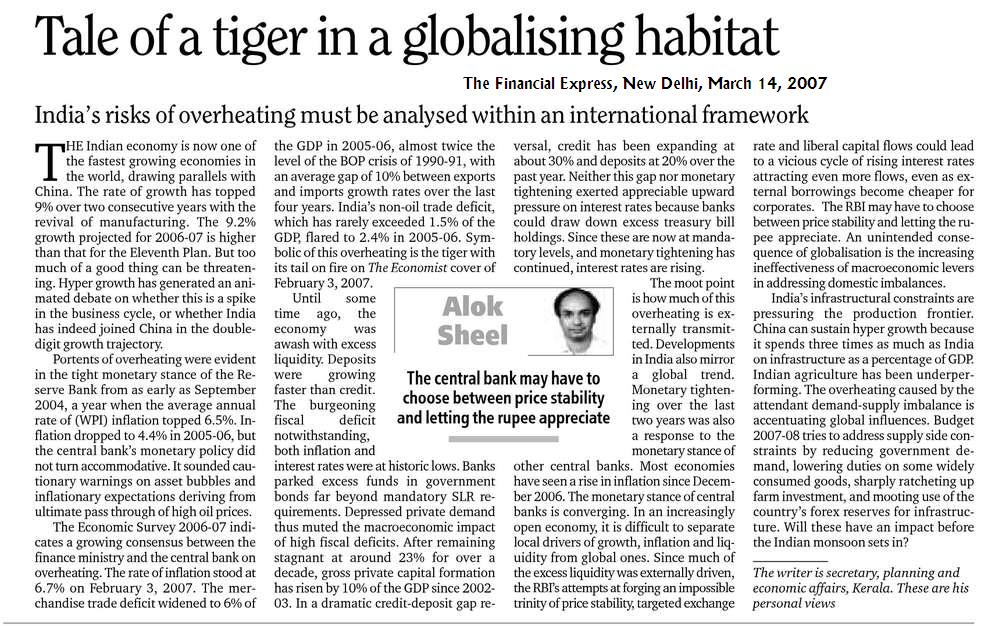
- “Tale of a Tiger in a Globalizing Habitat”, The Financial Express, New Delhi, March 14, 2007 (Print Version)
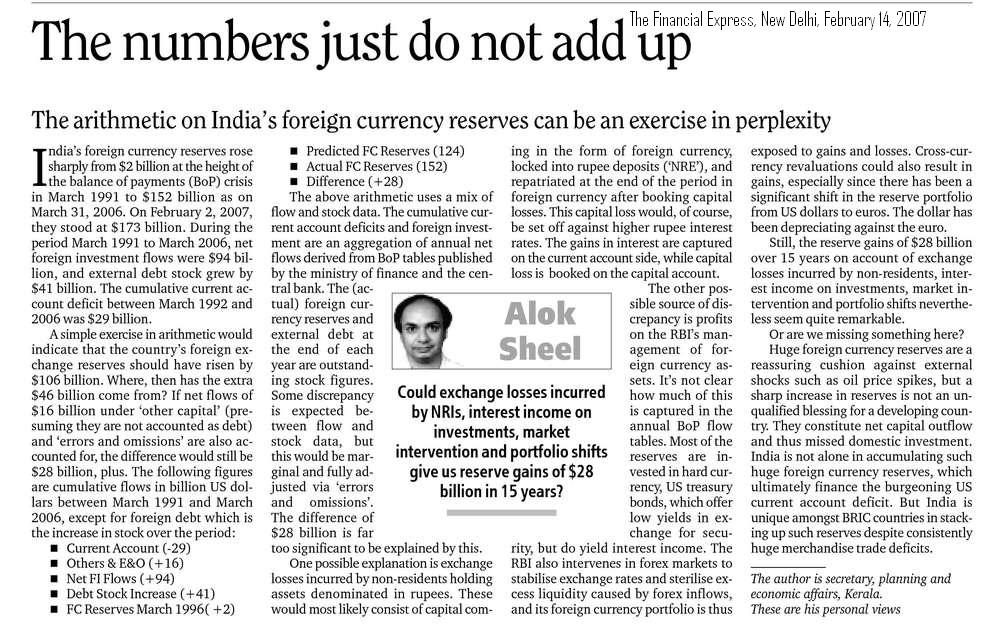
- “Reserves Just Do Not Add Up”, The Financial Express, New Delhi, February 14, 2007 (Print Version)
- “Milton Friedman and India”, The Economic Times, New Delhi, February 2, 2007 (Print version)
- “The Looming Freshwater Crisis”, The Financial Express, New Delhi, January 18, 2007 (Print Version)
- “Financing Infrastructure” , The Economic Times, New Delhi, January 5, 2007 (Print version)
- “The Measure That Will Uplift the Masses”, The Financial Express, New Delhi, December 20, 2006 (Print Version)
- “Understanding the RBI’s Monetary Trinity”,The Financial Express, New Delhi, November 22, 2006 (Print Version)
- "Prometheus Unbound?", The Economic Times, New Delhi, November 21, 2006 (Print version)
- " Wanted: Economists for the 21st Century", The Financial Express, New Delhi, October 25, 2006 (Print Version)
- " Let the Digital revolution Touch All Lives", The Financial Express, New Delhi, September 27, 2006 (Print Version)
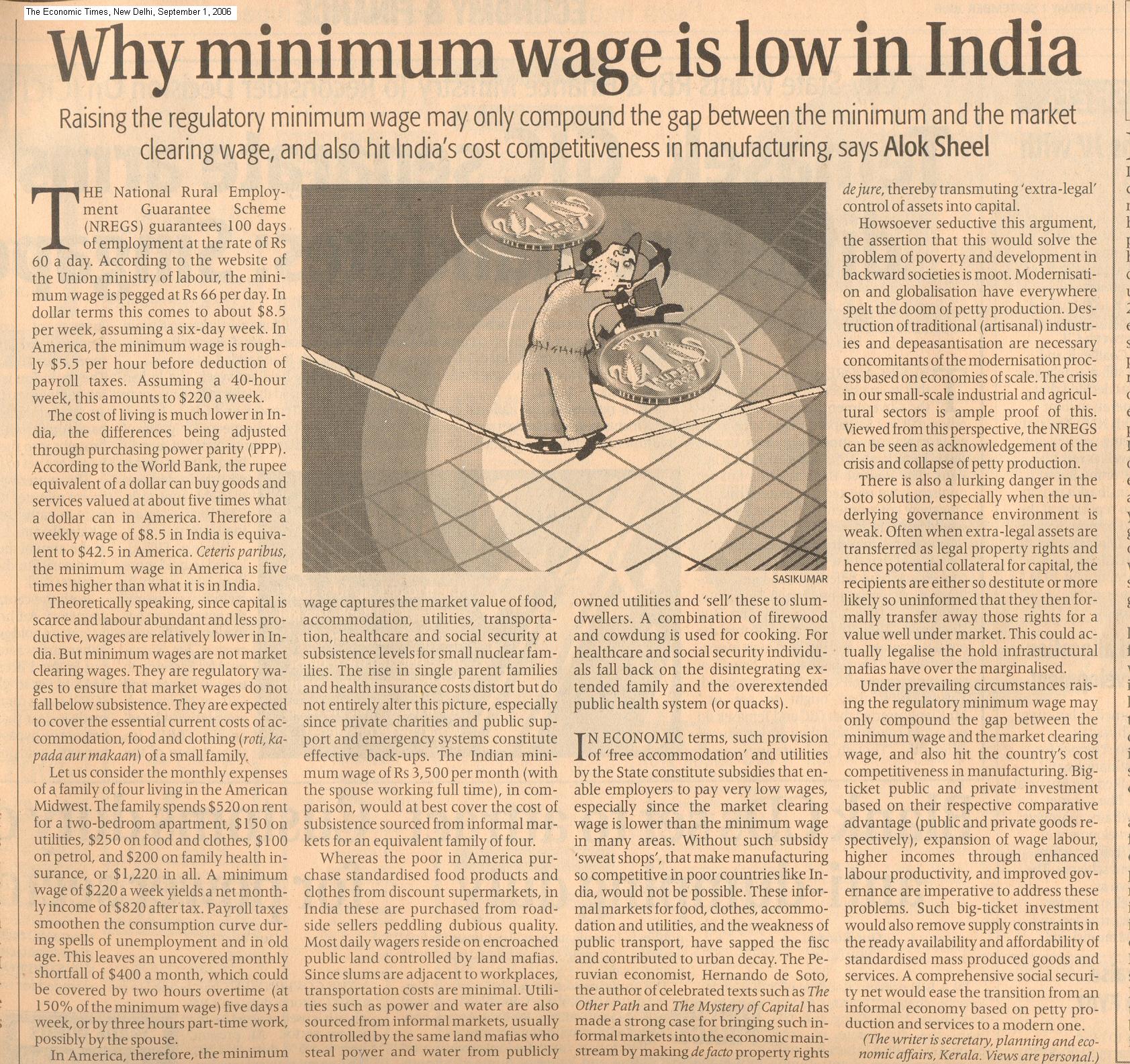
- "Why Minimum Wage Is Low in India", The Economic Times, New Delhi, September, 2006 (Print version)
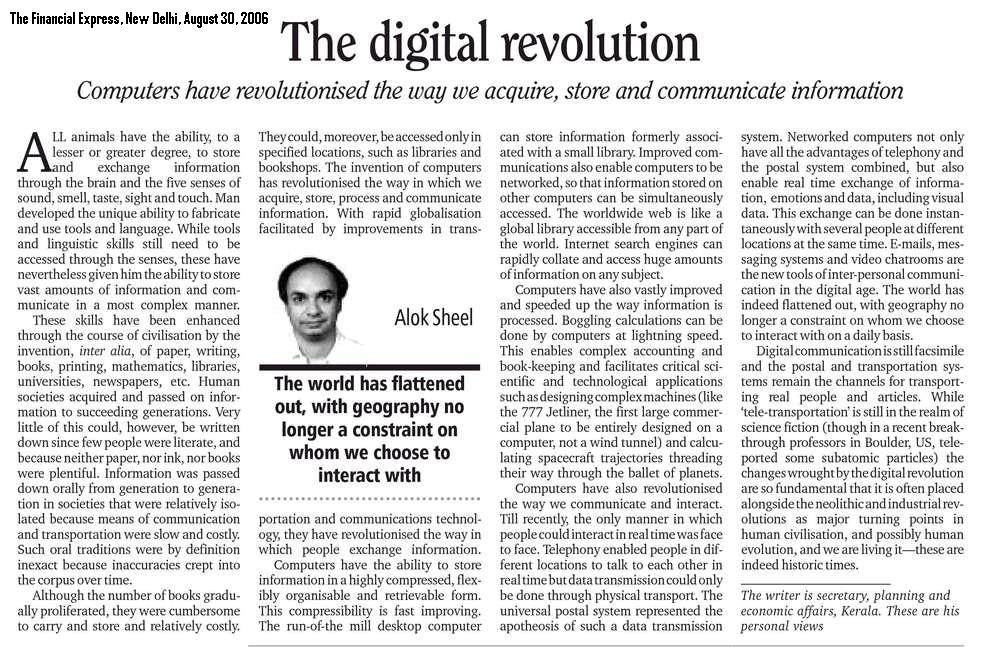
- "The Digital Revolution", The Financial Express, New Delhi, August 30, 2006 (Print Version)
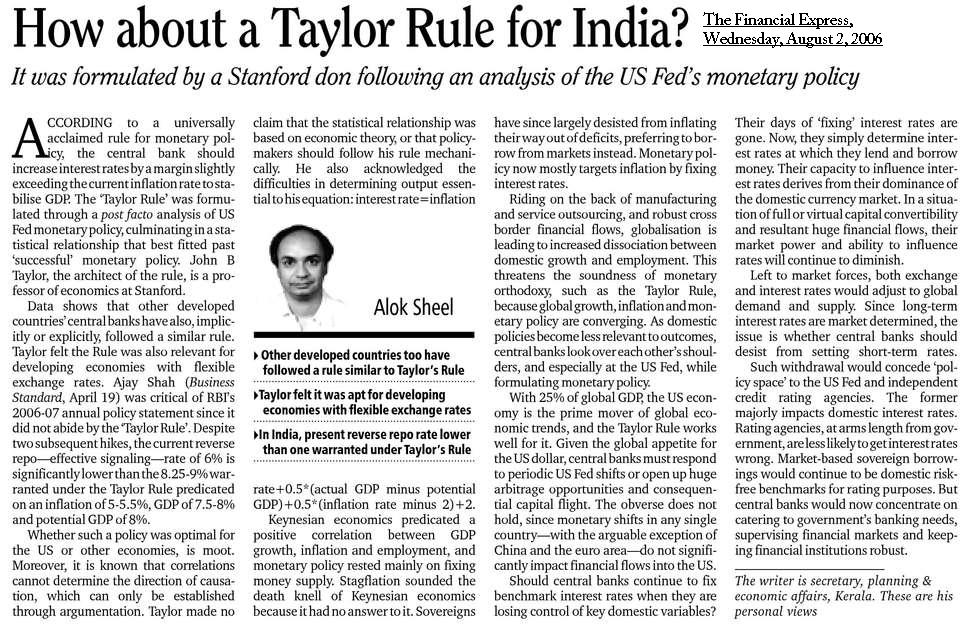
- “How About A Taylor Rule for India?”, The Financial Express, New Delhi, August 2, 2006 (Print Version) [TAYLOR RULE CALCULATOR]
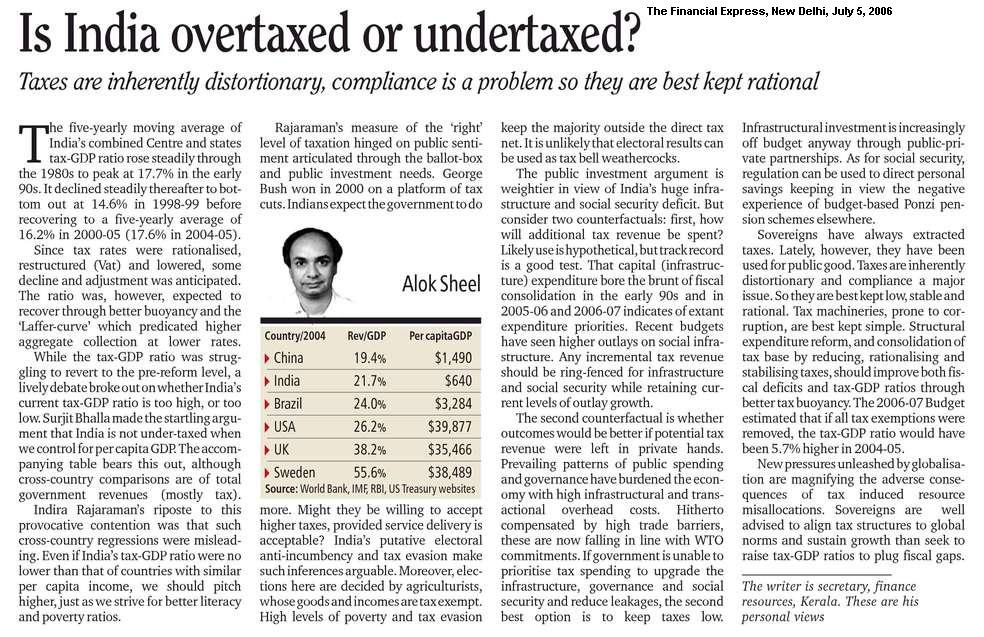
- “Is India Overtaxed or Undertaxed?”, The Financial Express, New Delhi, July 5, 2006 (Print Version)
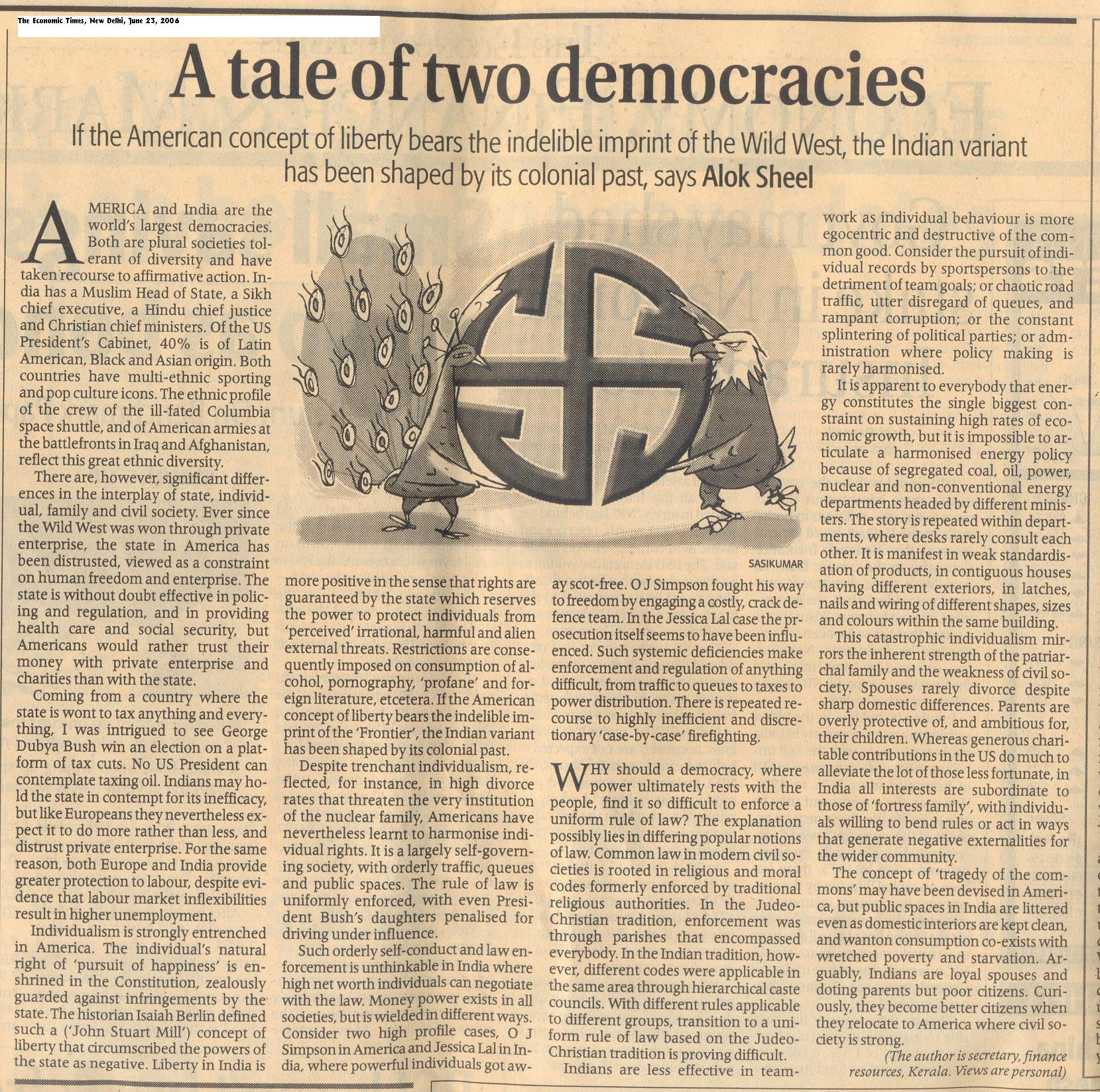
- “A Tale of Two Democracies”, The Economic Times, New Delhi, June 23, 2006 (Print version)
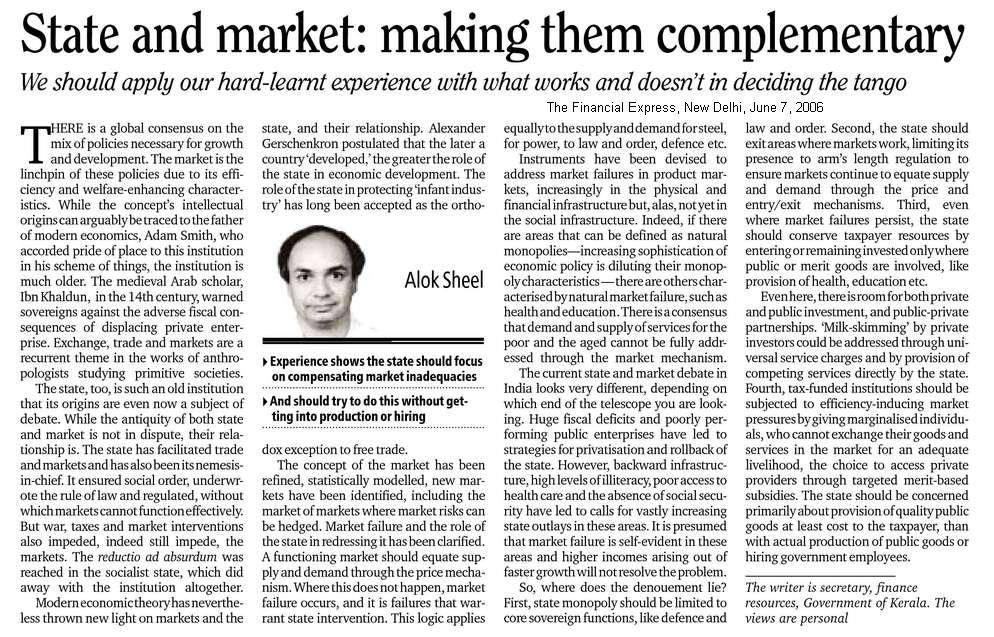
- “State and Market: Making Them Complementary”, The Financial Express, New Delhi, June 7, 2006. (Print version)
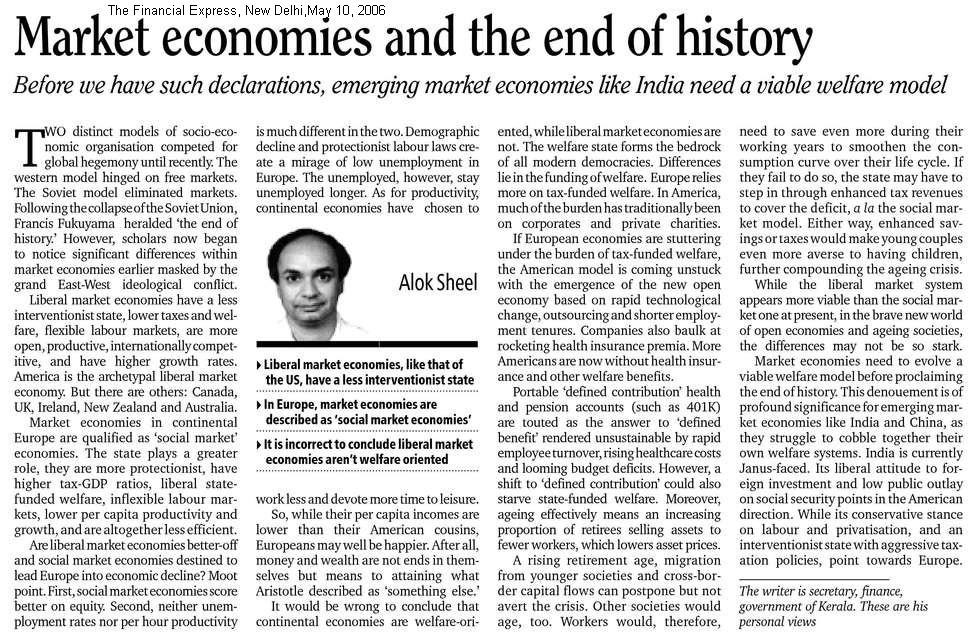
- “Market Economies and the End of History”, The Financial Express, New Delhi, May 10, 2006. (Print version)
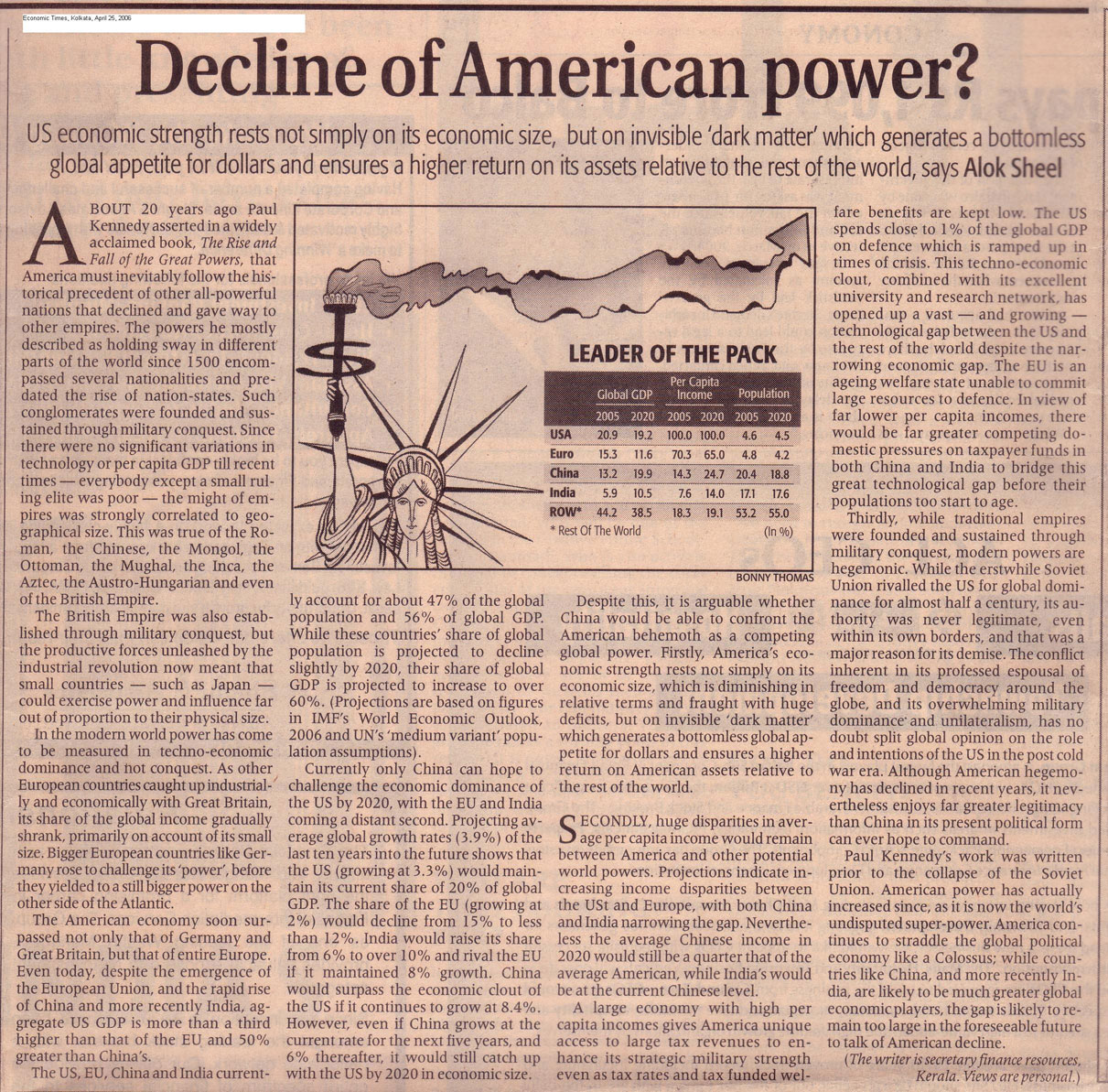
- “Decline of American Power?”, The Economic Times, New Delhi, April 25, 2006 (Print version)
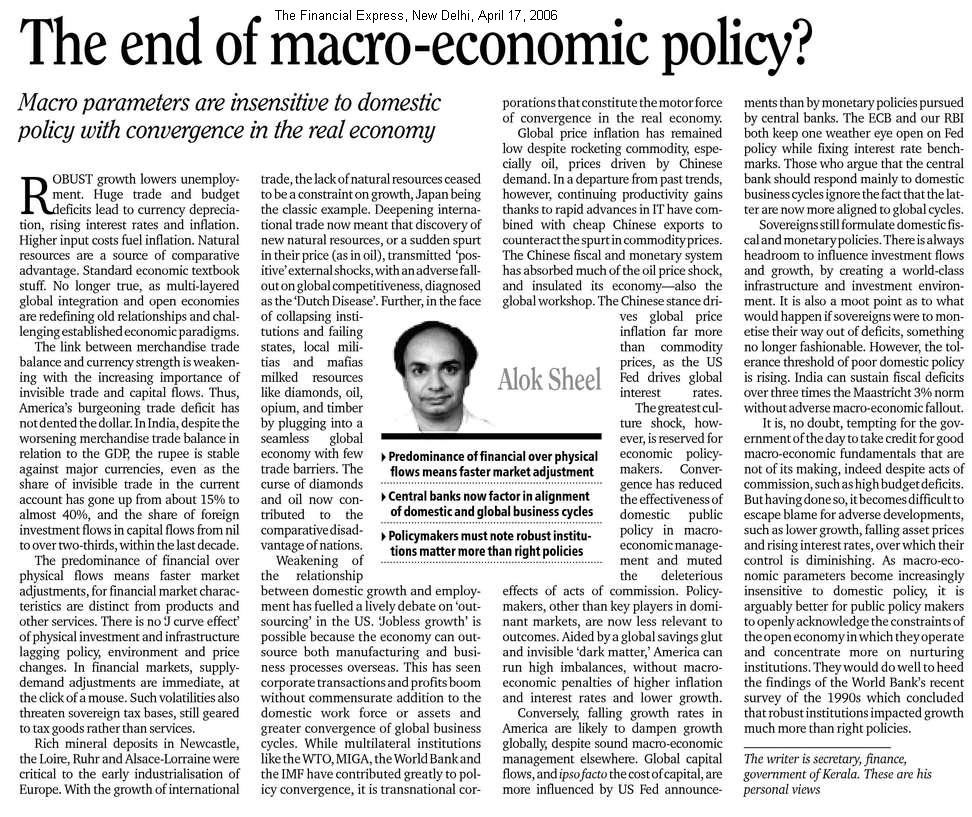
- “The End of Macro-economic Policy?”, The Financial Express, New Delhi, April 17, 2006. (Print version)
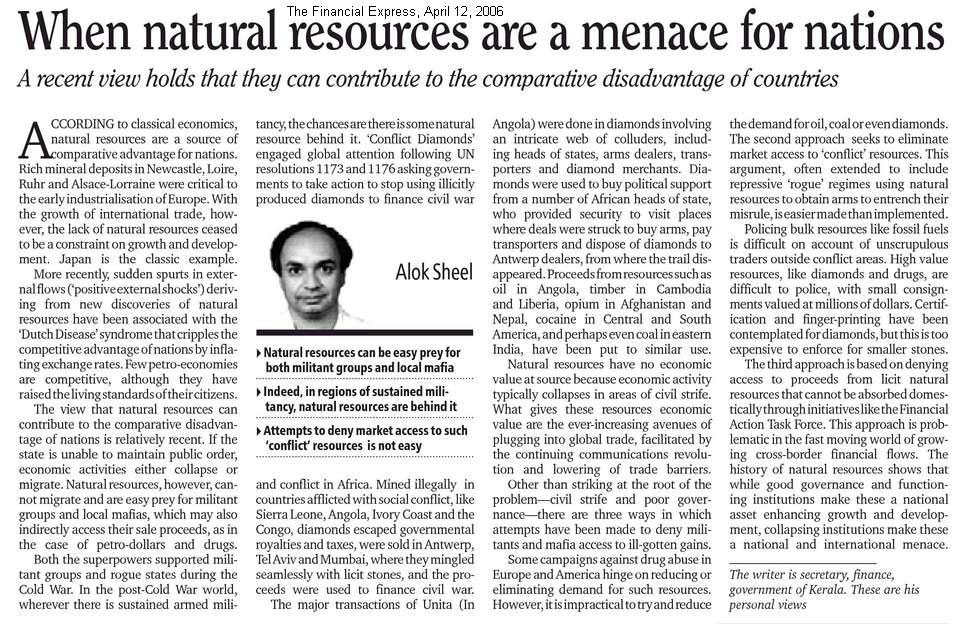
- “When Natural Resources are a Menace for Nations”, The Financial Express, New Delhi, April 12, 2006. (Print version)
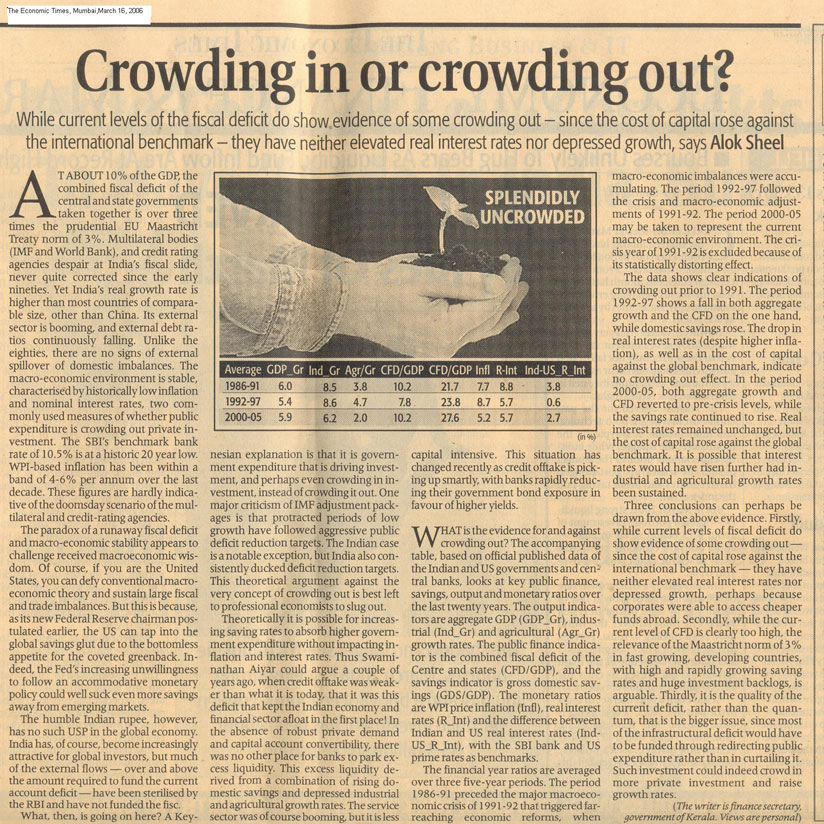
- “Crowding In or Crowding Out?”, The Economic Times, Bombay, March 16, 2006 (Print version)
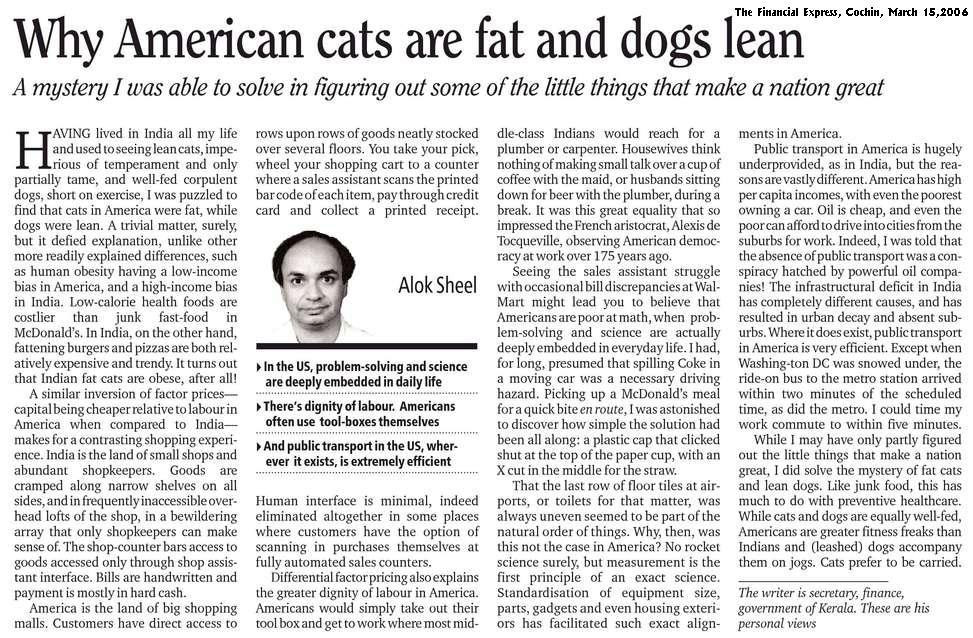
- “Why American Cats are Fat and Dogs Lean”, The Financial Express, New Delhi, March 15, 2006. (Print version)
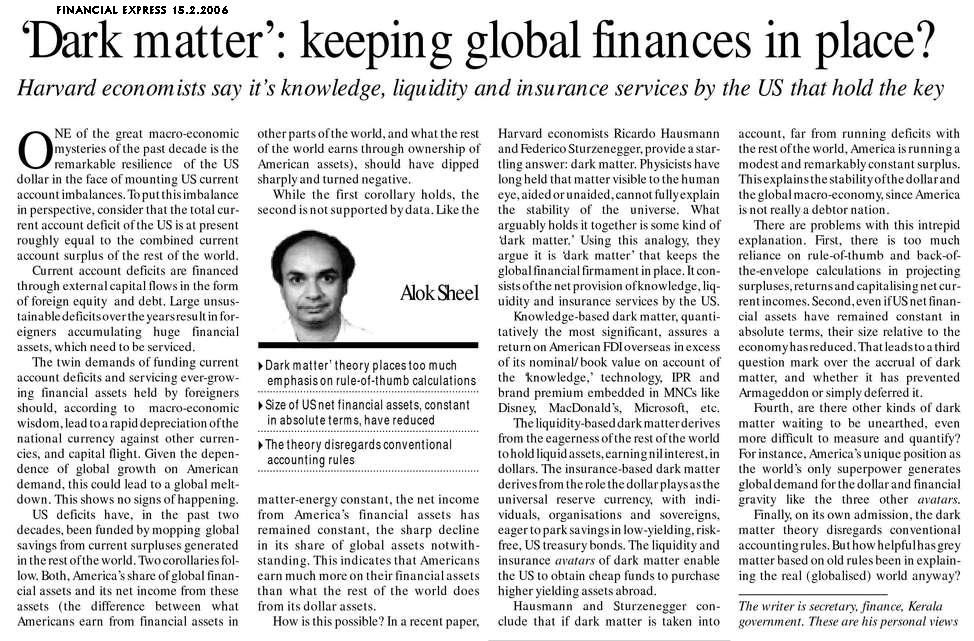
- “Dark Matter: Keeping Global Finances in Place?”, The Financial Express, New Delhi, February 15, 2006. (Print version)
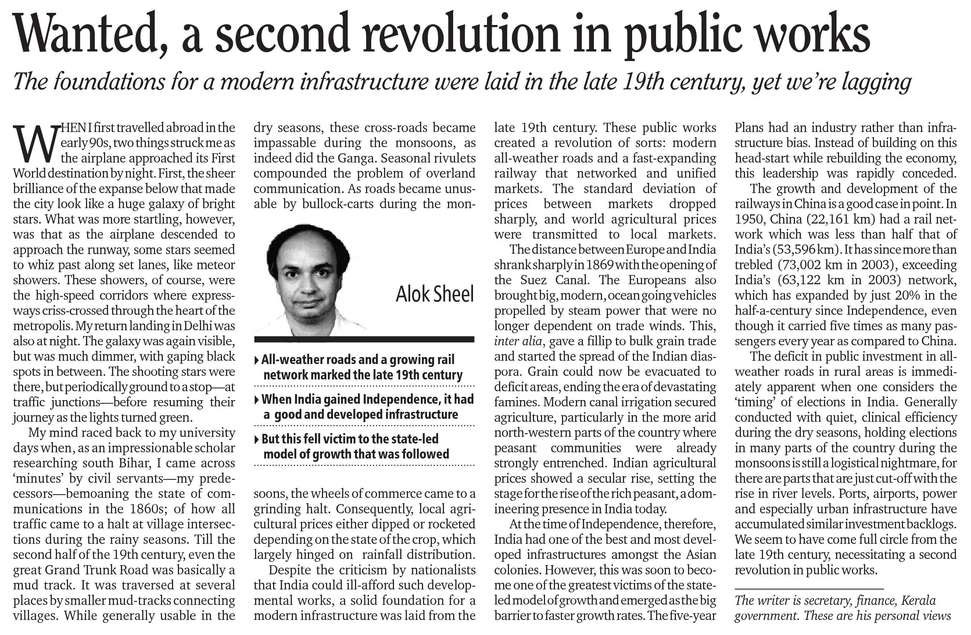
- “Wanted, A Second Revolution in Public Works” , The Financial Express, New Delhi, January 19, 2006. (Print version)
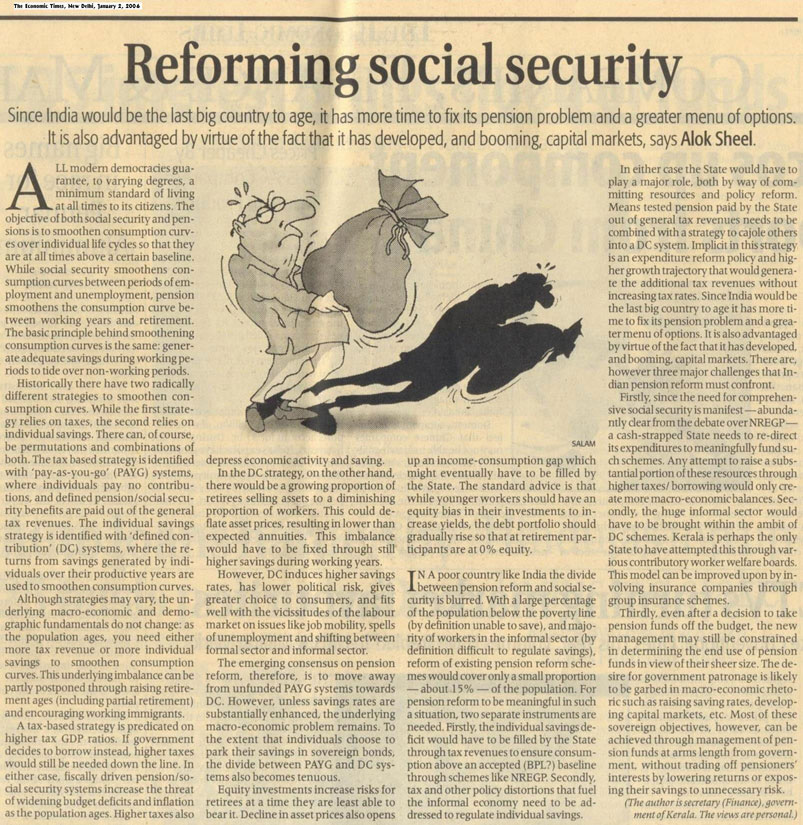
- "Reforming Social Security", The Economic Times, New Delhi, January 2, 2006 (Print version)
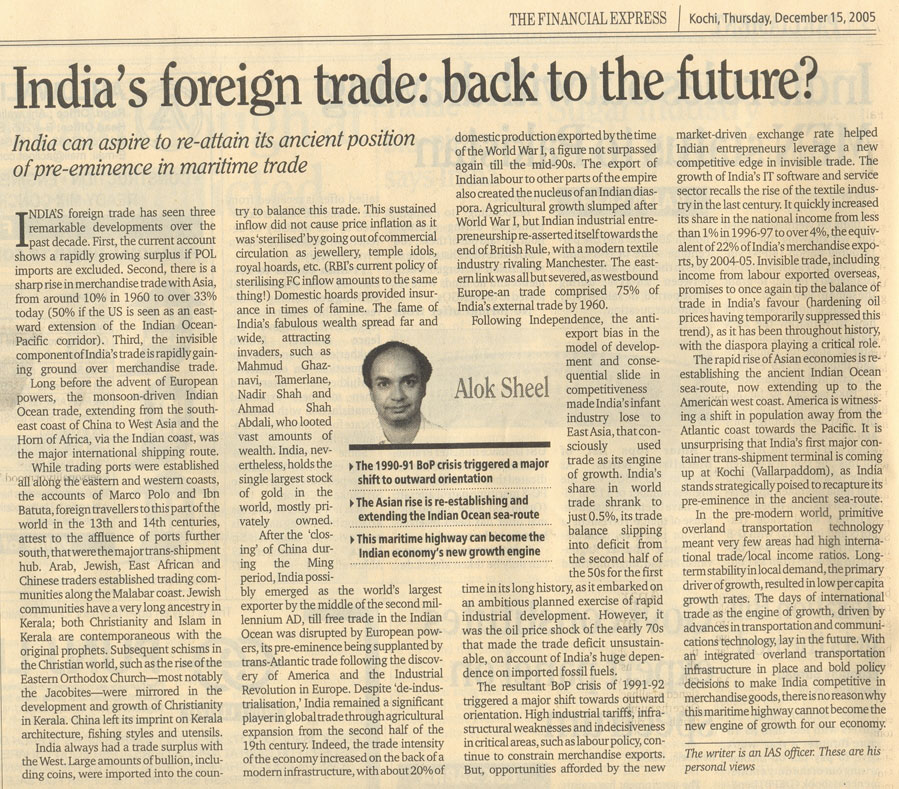
- "India's Foreign Trade: Back to the Future?", The Financial Express, New Delhi, December 15, 2005. (Print version)
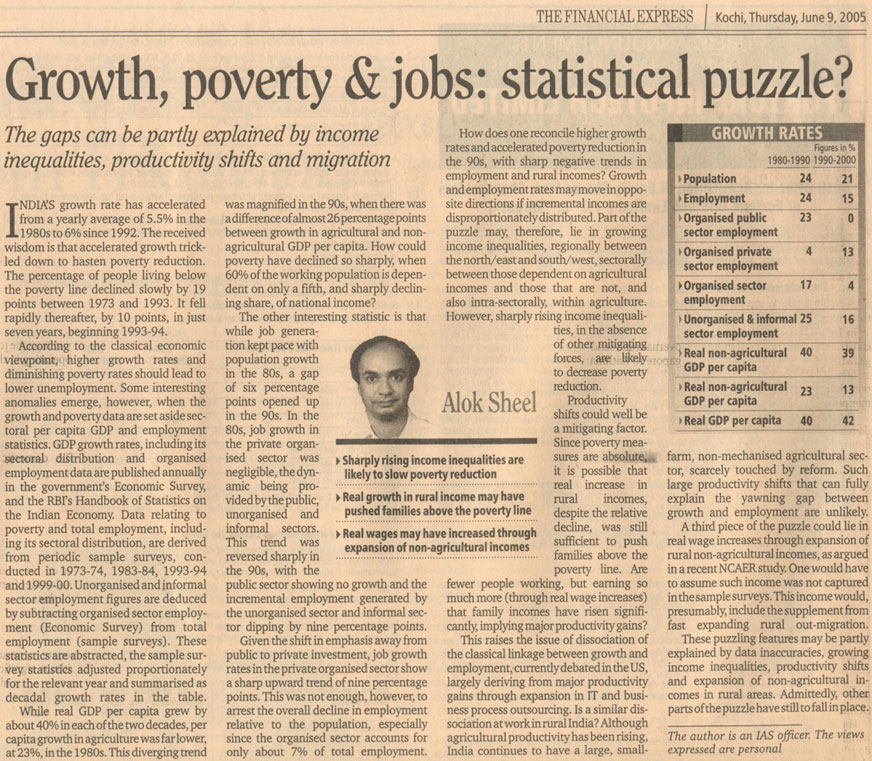
- “Growth, Poverty and Employment: Statistical Puzzle?”, The Financial Express, New Delhi, June 9, 2005. (Print version)
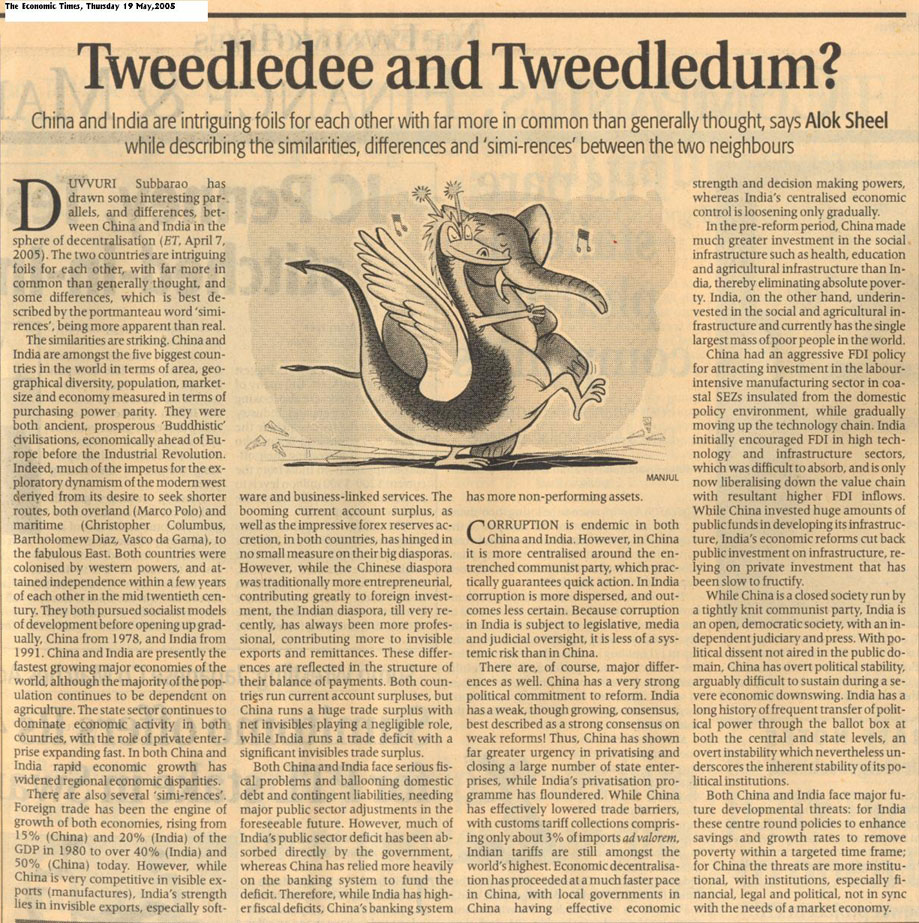
- “Tweedledee and Tweedledum?”, The Economic Times, New Delhi, May 19, 2005 (Print version)
- “Agriculture: Cutting the Gordian Knot”, The Financial Express, New Delhi, March 23, 2005 (Print version)
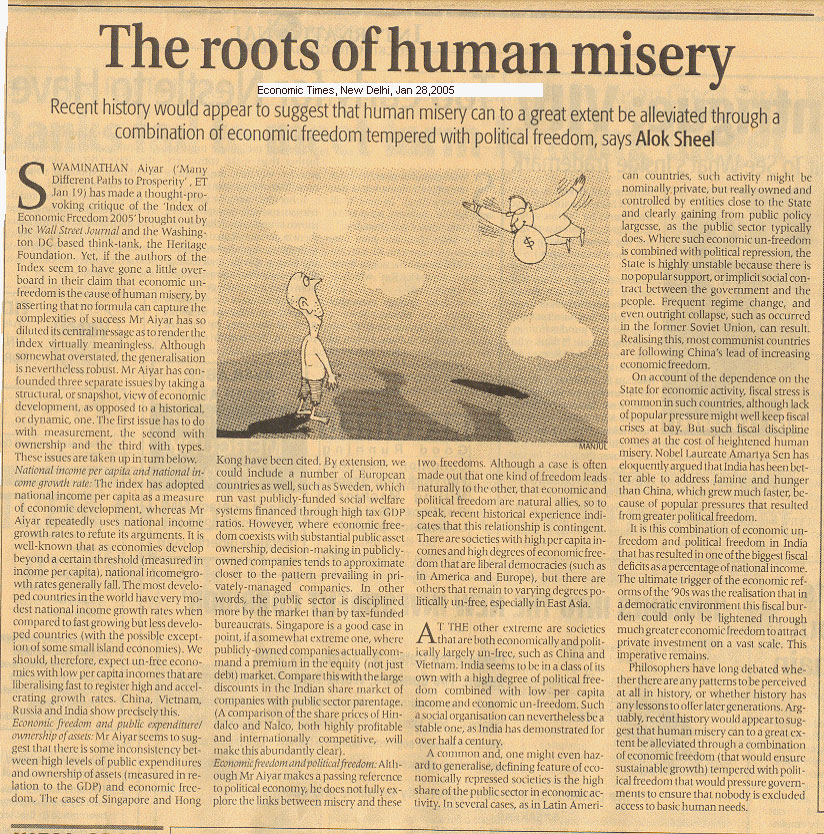
- “The Roots of Human Misery”, The Economic Times, New Delhi, January 28, 2005. (Print version)
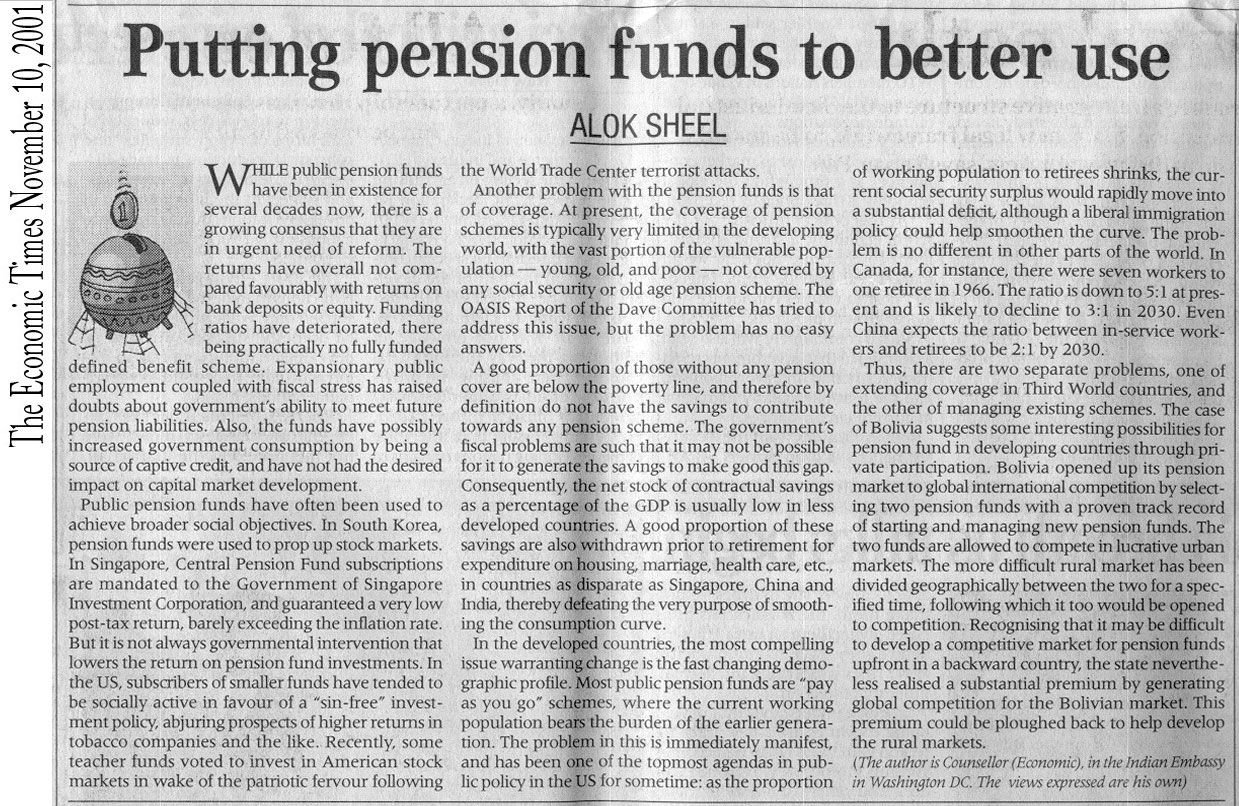
- “Putting Pension Funds to Better Use”, The Economic Times, New Delhi, November 10, 2001.(Print version)
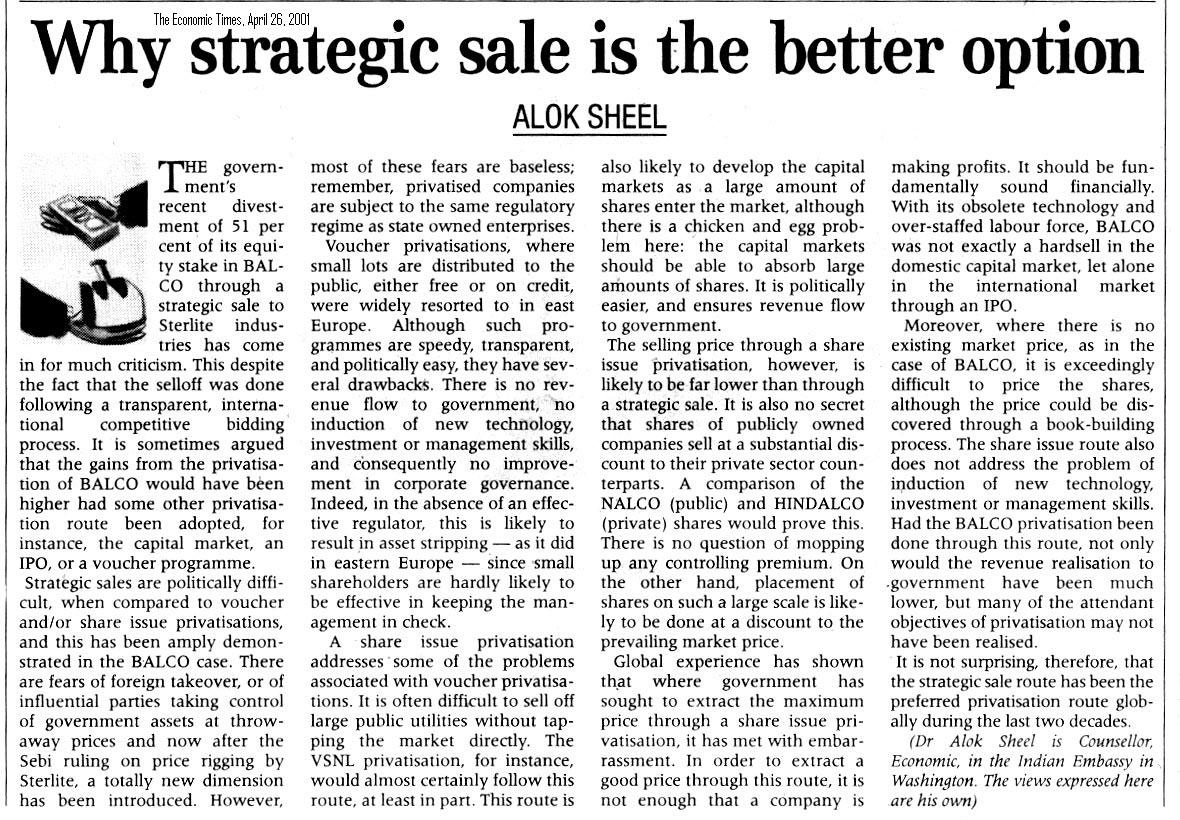
- “Why Strategic Sale is the Better Option”, The Economic Times, New Delhi, April 26, 2001.
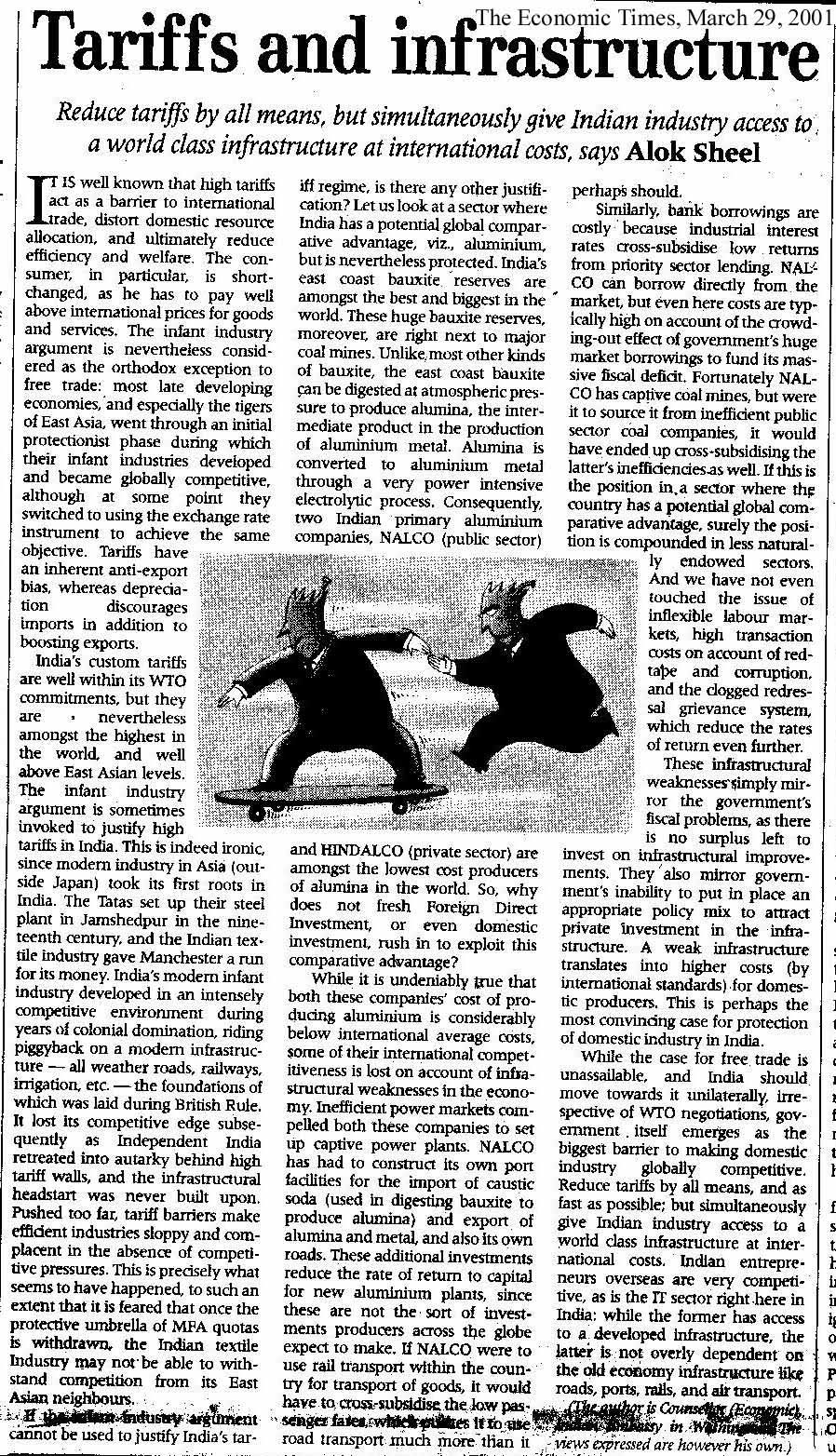
- “Tariffs and Infrastructure”, The Economic Times, New Delhi, March 29, 2001.
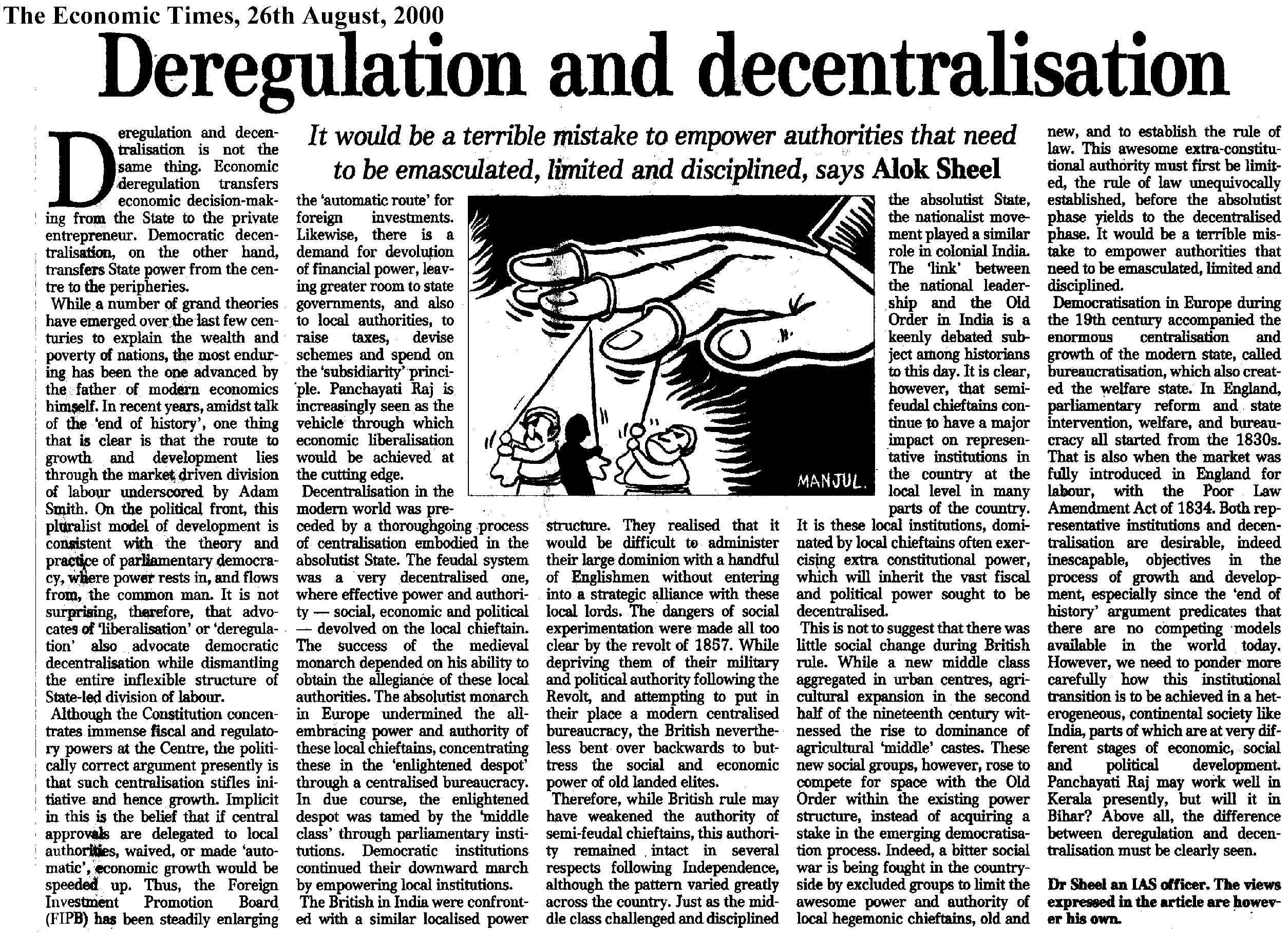
- "Deregulation and Decentralization", The Economic Times, New Delhi, August 26, 2000.
- "India: An Attractive Destination for FDI?", The Economic Times, New Delhi, April 22, 2000.
- "Re-invent the Collector: A District CEO?", The Economic Times, New Delhi, March 11, 2000.
- "Budget Constraint or Self Restraint?" The Economic Times, New Delhi, December 16, 1999. Reprinted in ICFAI Reader, Volume 2: 1 January 2000, The Institute of Chartered Financial Analysts of India, Hyderabad, India.
- "Privatization Made Easy", The Economic Times, New Delhi, November 23, 1999.
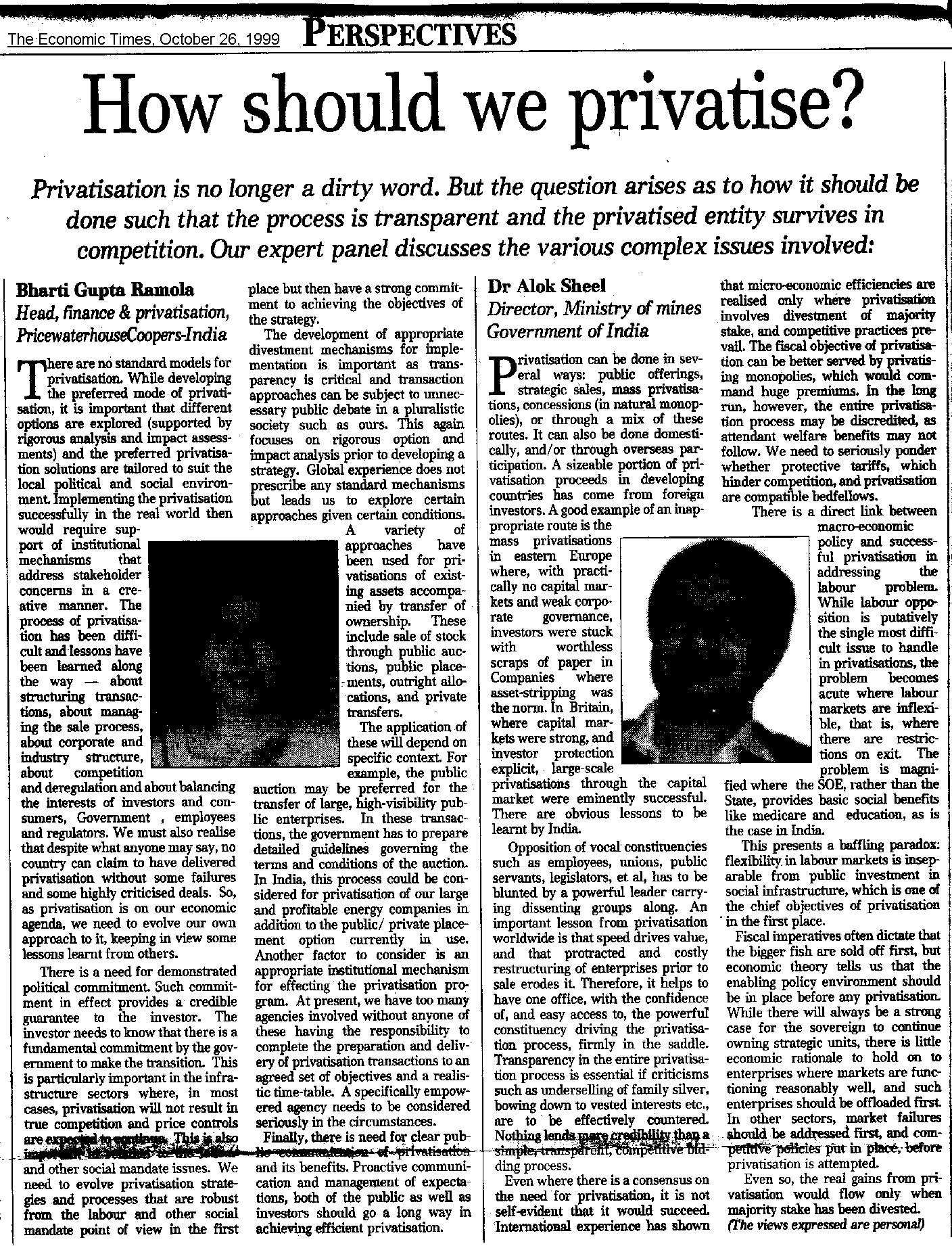
- "How Should We Privatize?", Perspectives, The Economic Times, New Delhi, October 26, 1999.
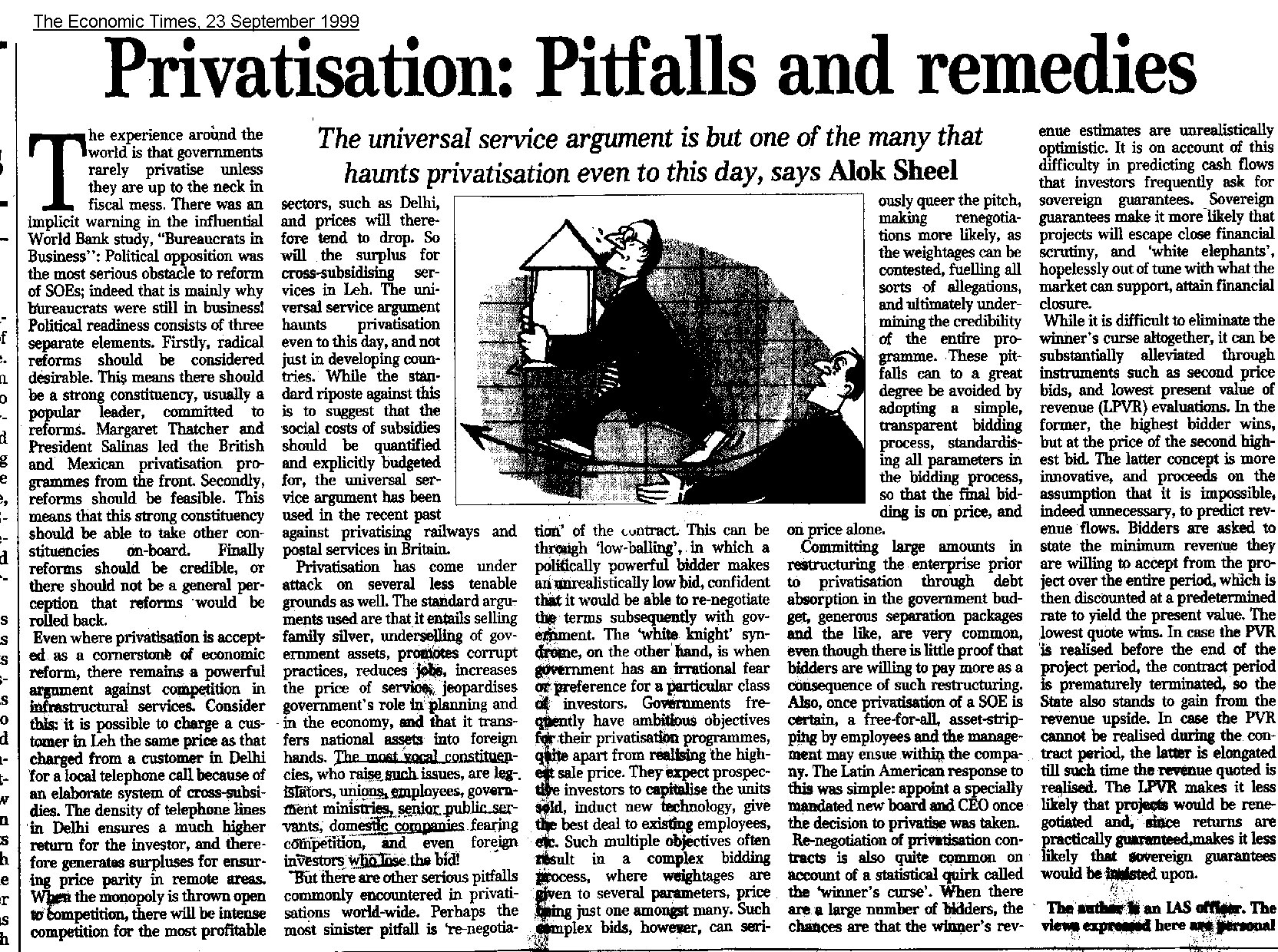
- "Privatization: Pitfalls and Remedies", The Economic Times, New Delhi, September 18, 1999.
- "The Privatization Wheel", The Economic Times, New Delhi, September 4, 1999. Reprinted in ICFAI Reader, Volume 1: 11, October 1999, The Institute of Chartered Financial Analysts of India, Hyderabad, India.

.07
PowerPoint Presentations
PowerPoint Presentations
- “International Experience in Privatization”, Venue: National Institute of Financial Management, Faridabad, Haryana, India. Date: 2000.
- “Indian Economy 1980-2000” at the Wharton India Economic Forum, 2001, Wharton Business School, University of Pennsylvania, Philadelphia, USA. Venue: Sheraton University City Hotel, Philadelphia, PA, USA. Date: November 30, 2001.
- “The Indian Economy, 1947- 2001” at the Department of Economics. Venue: Department of Economics, Wesleyan University, Middletown, New Haven, Connecticut, USA. Date: April 3, 2002.
- “A Contemporary History of India”, at the Department of History, Venue: CSS Lounge, Wesleyan University, Middletown, New Haven, Connecticut, USA. Date: April 4, 2002.
- “External Assistance: Indian Experience”, to students of the International Development Class at the American University. Venue: American University, Washington DC, USA. Date: November 23, 2002
- “Intellectual Property Rights and India” , for American diplomats of the Foreign Services Institute of the US State Department. Venue: Embassy of India, Washington DC, USA. Date: November 25, 2002.
- “Trends in India’s Balance of Payments”. Roundtable on “State of the Indian Economy” Association of Indian Economic Studies, Jan.3, 2003. Annual Meeting of the American Allied Social Science Associations, Jan 3-5, Renaissance Hotel, Washington D.C., USA.
- “Global Monetary and Financial Issues in Uncertain Times”, James E. Smith Midwest Conference on World Affairs 2003. The Global Economy: Promises and Perils of an Uncertain Frontier. Venue: University of Nebraska, Kearney, Nebraska, USA. Date: March 9-11, 2003
- “Collaboration and Competition between Global High Technology Clusters. Focus: India”, Centre for Information Technology and the Global Economy (CITGE) Conference on Collaboration and Competition between Global High technology Clusters”, Kogod School of Business, American University, Washington D.C, USA. Date: May 5, 2003.
- “The Rise of the Indian Software Industry”, Kogod School of Business, American University, Washington DC, USA. Date: September 11, 2003
- “Prospects of Economic Reforms in India”, Business & Professional Success in the High-Tech World, 12th Annual Convention of the American Society of Engineers of Indian Origin, Venue: Holiday Inn, Gaithersburg, Maryland, USA. Date: November 2, 2003.
- "Indian Aluminium Industry in Global Perspective", Venue: The Energy Research Institute, Habitat centre, Lodi Road, New Delhi, India. Date: August 23, 2005.
- “India: Public Finance and Development 1980-2005”, University of Manchester, Institute of Development Policy and Management. Venue: Mascot Hotel, Trivandrum, Kerala, India. Date: January 22, 2006.
- “State Finances: Fiscal, Debt and Liquidity Management”, Venue: Centre for Public Policy, Indian Institute of Management, Bangalore, Karnataka, India. Date: April 4, 2006.
- "Financing Government Expenditure", Kerala Development Society, Seminar on "Kerala's Development in a Globalized Scenario: Fiscal Issues", Venue: India International Centre, New Delhi, Date: September 2, 2006.
- "Sub Prime and the Crisis in Structured Finance", Venue: Indian Centre for Research in International Economic Relations (‘ICRIER’) Date: 3 P.M., April 9, 2008.
- “The Sub Prime Crisis and its Impact on India”, Public Lecture, Department of Business Economics, University of Delhi. Date: September 12, 2008, 3:30 PM. Venue: S.P.Jain Auditorium, South Campus, New Delhi.
- “Housing Options for the Urban Poor”, National Workshop on “Affordable Housing for Urban Poor” Indian Institute of Public Administration New Delhi, October 16-17, 2008. Sponsored by Ministry of Housing & Urban Poverty Alleviation Government of India.
- “Indian Economic Scenario: Challenges and Prospects”, “Seminar on Doing Business with India” for Senior Executives of European Companies, Management Development Institute, Gurgaon, Haryana, India. Venue: Hotel Shangri-la, Janpath, New Delhi. Date: October 21, 2008, 1145-1245 hours.
- “The International Financial Crisis: India and G 20 Initiatives”, International Conference on Global Economic Downturn: Lessons and Way Forward, Organised by Indian Council for Research in International Economic Relations, in Collaboration with Konrad Adenauer Stiftung, Germany and Sasakawa Peace Foundation, Japan, 9-10 February 2009, Venue: ASSOCHAM House, 47, Prithviraj Road , New Delhi.
- “Managing the International Financial Crisis: An Indian Perspective”, The Growth Commission for Development, Financial Crisis and its Impact on Developing Countries' Growth Strategies and Prospects, April 20-21, 2008, Venue: John F. Kennedy School of Government, Harvard University, 79 John F. Kennedy Street, Cambridge, Massachusetts, USA.
- “The Global Financial Crisis and the New Global Financial Architecture”, International Conference On BRICS IN THE NEW WORLD ORDER , Observer Research Foundation in Collaboration with The Ministry of External Affairs, Government of India, 13-14 May 2009, New Delhi. Venue: Observer Research Foundation, New Delhi
- “Responses to and Implications of the Global Financial Crisis”, 8th India-Korea Dialogue, India, Korea and the Global Financial Crisis: Co-operation and Responses. Indian Council for Research in International Economic Relations, New Delhi, India, and The Seoul Forum for International Affairs, Seoul, Korea, 20-21 May 2009. Venue: Shangri-La Hotel, New Delhi.
- “A Conference on India in the G 20:Macroeconomic Policy Coordination, Regulation and Global Governance”, organized by The Centre for Economic Policy Research (CEPR) and National Council of Applied Economic Research (NCAER). Sponsored by the British High Commission, New Delhi, June 1, 2009 Venue: The Claridges, New Delhi.
- “The Global Economic Crisis and its Implications for India”, Roundtable, Sixth Annual India Policy Forum, organized by National Council of Applied Economic Research, New Delhi, and The Brookings Institution, Washington D.C. July 15, 2009. Venue: Jacaranda, India Habitat Centre, New Delhi.
- "Managing the Global Financial Crisis", Lecture for Indian Economic Service Probationers, August 7, 2009, at the Institute of Economic Growth. University of Delhi Enclave, New Delhi, India.
- “The International Financial Crisis and Fiscal Policy: An Indian Perspective”, National Workshop on Strengthening the Response to the Global Financial Crisis in Asia-Pacific: The Role of Monetary, Fiscal and External Debt Policies Jointly organized by UNESCAP/UNDP/Royal Monetary Authority of Bhutan. 9-11 December 2009, Thimpu, Bhutan.
- “The Macroeconomic Policy Response to the International Financial Crisis through an Indian Prism”, International Conference on Financial Sector Regulation and Reforms in Asian Emerging Markets, Jointly organized by The Brookings Institution, Cornell University, Asian Development Bank Institute, International Center for Financial Regulation, K. Foreign and Commonwealth Office. February 8, 2010. Venue: Taj Palace and Towers, Mumbai, India.
- “Policy Response to the Global Financial Crisis and India-Japan Cooperation” Workshop jointly organized by Indian Council for Research on International Economic Relations (ICRIER), New Delhi, India, and Policy Research Institute (PRI), Ministry of Finance, Japan. February 15-16, 2010. Venue: ICRIER Conference Room, India Habitat Centre, New Delhi, India.
- “Long-Term Growth in the United States: Policies and Strategies”, Workshop organized by Department for International Development, U.K.; the National Council for Applied Economic Research, New Delhi, India; New York University’s Stern School of Business; and the World Bank on Restoring Inclusive Growth in Advanced Economies: A Conversation with Economists and Policy Makers from G20 Countries October 7-8, 2010 New York University, School of Law, Furman Hall, 245 Sullivan Street, New York, NY 10012.
- “Infrastructure Pillar”, G20 High-Level Development Conference, organized by the Presidential Committee for the G20 Seoul Summit, October 13, Lotte Hotel, Seoul, Republic of Korea.
- “The Global Financial Crisis, Sustainable Growth and the Rise of the G 20”, Indian Institute of Technology, Kanpur, Department of Industrial Management Engineering MBA, Finatics 2011, April 9, 2011.
- “Indian Policy Response to the Global Financial Crisis”, NIPFP/IMF Conference: Promoting Fiscal Sustainability through Strengthening Fiscal Institutions and Medium-Term Budget Frameworks, April 21–22, 2011, Venue: Magnolia Hall, India Habitat Centre, New Delhi.
- “The Global Financial Crisis and the Crisis in Public Finance”, Centre for Training in Financial Management, Finance Department, Government of Kerala. Trivandum, Kerala, December 3, 2012. Youtube
- “Indian Macro-economic Outlook”, Presentation for Embassy of Finland in India, Taj Palace, New Delhi, January 14, 2013.
- “Global Macro-economic Scenario” and “Indian Macro-economic Scenario”, presentations for the 7th Advanced Mid-Career Training Program for Additional Commissioners of Income Tax, Management Development Institute, Gurgaon, New Delhi, May 17, 2013.
- “The Aftermath of the Global Economic Crisis: Return of Fiscal Dominance – G 20 Experience”, National Institute of Public Finance and Policy, New Delhi, August 19, 2013.
- “Current State of the Indian Economy: Issues, Challenges and Outlook”, Securities and Exchange Board of India Discussion Forum, SEBI Bhawan, Bombay, September 17, 2013.
- “Reforming the Global Financial System: Implications for Long-term Investment Finance”, Indian Council for Research on International Economic Relations, Governance and Development: Views from G 20 Countries, September 17-19, Jacaranda Hall, India Habitat Centre, New Delhi, India.
- “Monetary Policy and the Great Recession”, Department of Business Economics, University of Delhi South Campus, 40th ANNUAL CONVENTION, “EMBRACING UNCERTAINTY: INDIA IN AN INTERCONNECTED WORLD”, October 7, 2013. Jacaranda Hall, India Habitat Centre, New Delhi.
- “Global Macro-economic Scenario” and “Current State of the Indian Economy: Issues, Challenges and Outlook”, Kalinga Institute of Industrial Technology, School of Leadership, Bhubaneshwar, Orissa, October 30 and 31, 2013. KIIT International School
- “The Operation of the G 20 to date: Emerging Country Perspectives”, (with Changyong Rhee, Chief Economist, ADB), The G 20 at Five Roundtable, Crawford School of Public Policy, East Asia Bureau of Economic Research (EABER), Australian National University and Brookings, China and the Future of the G 20 , G 20 and Global Governance Challenges, Venue: Australian National University, Canberra, Australia, November 14-15, 2013. https://www.youtube.com/watch?v=ZeikGUtwg-I
- “How Will Quantitative Easing Unravel?”, 6thICRIER Annual International Conference on Issues of Concern for G20 Countries, India Habitat Centre, New Delhi, August 21, 2014.
- “World Economic Outlook and New Sources of Growth: Strategic Priorities for the G 20”, Australian National University, Brookings India and National Institute for Public Finance and Planning, India-Australia G 20 Roundtable, Vivanta by Taj, Ambassador, Sujan Singh Park, New Delhi, September 10, 2014.
- “Role of External Drivers in India’s Growth”, (with P.K.Kareem) The EXIM Bank of India-JNU Economics Library, Centre for Economic Studies and Planning Seminar on India’s Macro-economy, School of Social Sciences, Jawaharlal Nehru University, New Delhi, February 11-13, 2015.
- “Is the G20 Framework for Strong, Sustainable and Balanced Growth Still Relevant?”, G20 Studies Centre, Lowy Institute for International Policy, Sydney, Australia, The Future of International Economic Governance and the G20, May 20-21, 2015, Lowy Institute for International Policy, 31 Blight Street, Sydney, Australia.
- “Public Finance”, Institute for Management in Government, Trivandrum, Kerala, Ist Induction Training Programme for I.A.S Officers, September 10, 2015.
- “Accelerating Infrastructure Investment in G 20 Countries”, Indian Council for Research on International Economic Relations (ICRIER), in partnership with the World Bank, International Monetary Fund (IMF), Asian Development Bank Institute (ADBI) and Konrad-Adenauer-Stiftung (KAS), 7th Annual G20 Conference on “Challenges to Strong, Sustainable and Balanced Growth: Views from G20 Countries” on September 14-15, 2015, India Habitat Centre, New Delhi. https://www.youtube.com/watch?v=x54y9ghr0-8
- “Public Finanance and Macroeconomic Management”, Indian Institute of Public Administration, New Delhi, 41st Advanced Programme in Public Administration, October 21, 2015.
- “Monetary Policy across Developed and Developing Countries”, Indian Institute of Public Administration, New Delhi, 42nd Advanced Programme in Public Administration, November 15, 2016.
- “Evaluating Global Financial Architecture and Regulatory Practices – Progress and the Way Forward”, Indian Council for Research on International Economic Relations (ICRIER), in partnership with the World Bank, International Monetary Fund (IMF), and Ford Foundation, 10th Annual International G20 Conference “ From Global Cooperation to Building Consensus: Views from G 20 Countries” on October 11-12, 2018, India Habitat Centre, New Delhi. https://www.youtube.com/watch?v=dz58jyfl7_I
61. "The Global Financial System", Foreign Services Institute, New Delhi, Induction Training Programme for the Indian Foreign Service (IFS) Officer Trainees of 2018 Batch, May 8, 2019.
62. "The Indian Economy", Dr Marri Channa Reddy HRD Institute, Hyderabad, Telengana, 94th Foundation Course for AIS and CCS Officers, September 17, 2019
63. "Financial Markets, Monetary Policy and the Impossible Trinity", Dr Marri Channa Reddy HRD Institute, Hyderabad, Telengana, 94th Foundation Course for AIS and CCS Officers, September 17, 2019
64. "The Indian Economy: Prognosis and Path Forward", ICFAI Business School, Gurgaon, Haryana, India. November 13, 2019.
65. "Monetary Policy and the Economy", Panel Discussion on the Indian Economy, Webinar hosted by Motilal Oswal Securities Ltd, June 24, 2020
66. "Multilateralism, The Global Economy and the G 20", Webinar on Multilateralism in a Transforming World: Challenges and Opportunities for India, Indian Council of World Affairs, December 10, 2020
67. "The G20,"Induction Training Programme for IFS Officer Trainees 2020 Batch, Sushma Swaraj Institute of Foreign Service, New Delhi, March 9, 2021
68. 3rd ICRIER – KAS Covid-19 WEBINAR ‘People, Planet, Prosperity: Rebuilding Differently’, September 13, 2021 Youtube (1:11:00 till the end)
69. 10th ICRIER-PRI Workshop, Policy Responses to COVID19 in India and Japan and Prospects for Economic Cooperation Going Ahead, March 22, 2022. Youtube link 1:14 to 1:21
Miscellaneous
- Inaugural Address at the ‘National Workshop on Macro Policy Environment, IPRs and Competition Policy’, Indian Institute of Management, Bangalore, Feb 18, 2014. Business Standard report. Deccan Herald report.
- Interview in Business and Economy, August 4, 2011, “The Main Risks to the Economy are External”
- “Bird Around Mussoorie” (Unpublished) January 2011.
- “India and Europe: Time for a Paradigm Shift?”, India Europe Forum, organized by the Presidency of the European Union, Instituto Cervantes, New Delhi, April 12-13, 2010, “The Challenges of Inclusive Growth, Globalization and Sustainable Development”, April 13, 1430-1745 hrs. venue: Instituto Cervantes, New Delhi.
- “A Seminar on Finance: The Challenges Ahead”, Keynote Speech at Arthasaar 2010, Fortune Institute of International Business, New Delhi, March 5, 2010.
- “The International Financial Crisis and Fiscal Policy: An Indian Perspective”, Paper presented at the National Workshop on Strengthening the Response to the Global Financial Crisis in Asia-Pacific: The Role of Monetary, Fiscal and External Debt Policies Jointly organized by UNESCAP/UNDP/Royal Monetary Authority of Bhutan. 9-11 December 2009, Thimpu, Bhutan.
- “Looking Beyond The Global Financial Crisis”, International Conference On BRICS IN THE NEW WORLD ORDER, Observer Research Foundation in Collaboration with The Ministry of External Affairs, Government of India, 13-14 May 2009, New Delhi.
- “The Financial Crisis: Lessons and Red Herrings”, Special April 2009 Feature on the Financial Crisis, The Growth Commission for Development (Blog)
- “Special Economic Zones in India: Some Debatable Issues”, National Conference on Special Economic Zones, September 18-20, 2008, Indian Institute of Advanced Studies, Shimla.
- "Financing Infrastructure: Issues and Challenges", Keynote Speech at Asian Development Bank Institute's (Tokyo, Japan) Flagship Study on “Infrastructure and Regional Cooperation”. 2nd Technical Workshop “Policies and Institutions and Financing Infrastructure”, Maurya Sheraton Hotel, New Delhi, India, 12-14 June 2008.
- 'Murphy's Law of Financial Crises', Comment in The Financial Times on "Can the Fed Stop the Rot?", dated March 19, 2008.
- "Some Fiscal Implications of Decentralization", Paper presented at the National Conference on Emerging Trends in State-Local Fiscal Relations, National Institute of Rural Development (NIRD), Hyderabad, & the Konrad Adenaeur Foundation, Germany, December 18-19,1996. 22.
- "Determinants and Management of India’s External Debt",sc Thesis, University of Bradford, U.K, August 1995.(Unpublished)
- "Liberalization and Restructuring of the Indian Economy", Paper presented at the Eighteenth International Seminar of Export-Import Bank of Japan, Tokyo, May 22-June 3,1993.
- “The Evolution of Agrarian Society in South Bihar : Shahabad and Gaya Districts, 1860 – 1920”, PhD Thesis, Centre for Historical Studies, Jawaharlal Nehru University, New Delhi, May 1990. (Unpublished).
- “The Congress and the Raiyat: A Study of Three Agrarian Movements, 1928-40”, MPhil Dissertation, Centre for Historical Studies, Jawaharlal Nehru University, New Delhi, 1980. (Unpublished).

.08
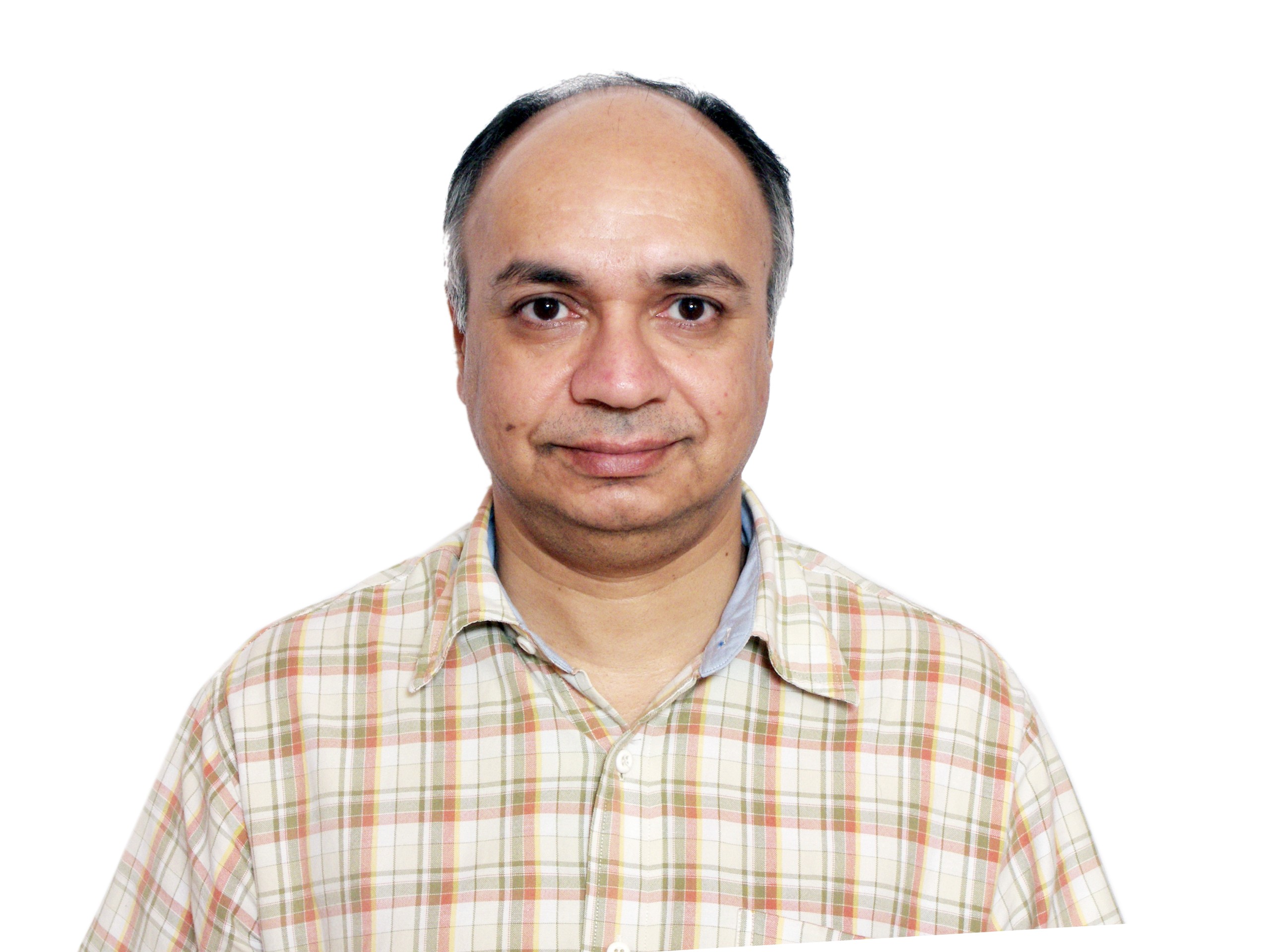
About me
I was schooled in Sherwood College, Nainital, a fully residential public school, set up over 150 years ago in the picturesque Kumaon region of the Garhwal Himalayas in the erstwhile State of Uttar Pradesh (now Uttarakhand) in India. I graduated with History Honours from St.Stephens, Delhi University, arguably India’s best liberal arts college. I went on to take a Masters, M.Phil and Ph.D in History from the Jawaharlal Nehru University, New Delhi, and joined the Indian Administrative Service [successor to the Indian Civil Service (ICS)] in 1982. I superannuated from the IAS on May 31, 2016.I am permanently settled in Gurugram (formerly Gurgaon) in the national capital region.
I was allotted to the Kerala Cadre of the I.A.S. Over the years I was entrusted with a number of important assignments, both under the Government of Kerala, as well as the Government of India. My experience in public administration spans a third of a century, both at the cutting edge of implementing government policies and exercising quasi-judicial sovereign authority, as well as in senior management and policy making, particularly in the area of economic policy. Apart from extended stints in the finance departments in both Kerala and the Government of India, I interfaced with multilateral financial institutions such as the World Bank, International Monetary Fund and UNDP, and also anchored India’s engagement with the G 20 following its emergence as the premier multilateral forum for international economic cooperation in the wake of the recent global financial crisis, being also the nodal officer in the Indian Prime Minister’s delegation to G 20 Summits. I also have diplomatic experience and have right from the beginning of my career interfaced with democratic representative institutions at all levels. My last posting was as Additional Chief Secretary, Planning and Economic Affairs, to the Government of Kerala, member Secretary State Planning Board, and Special Representative in New Delhi, to the Niti Ayog and Union Finance Ministry.
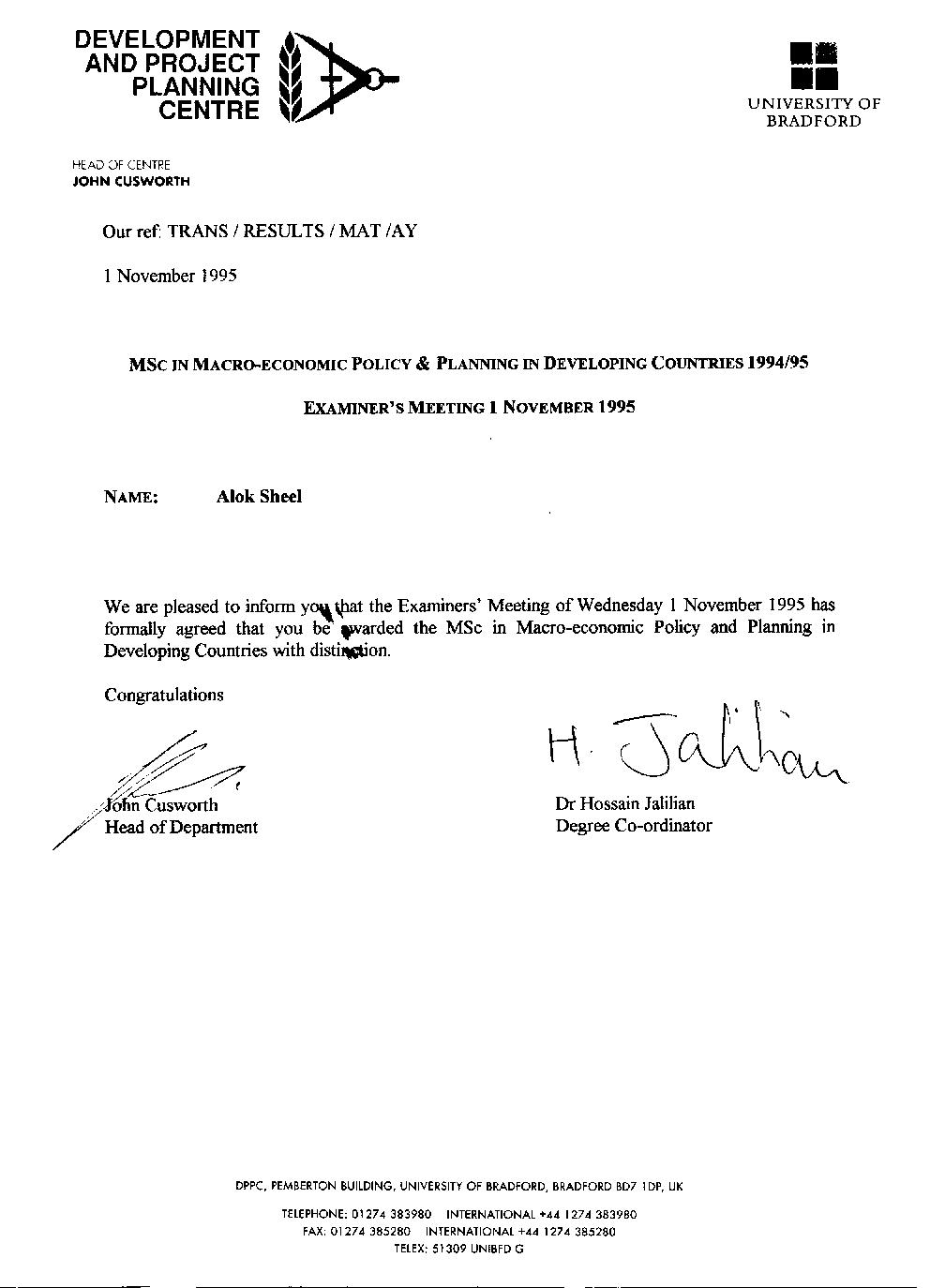
In 1995 I was admitted to the degree of M.Sc in Macro-economic policy (with distinction) by the University of Bradford, U.K. I have attended several workshops and seminars, given lectures and made presentations, in India and abroad, and also published several articles in international research journals and books, and opinion pieces in leading financial dailies, on a variety of themes, including the international economy and finance, monetary policy, general and economic administration, comparative economic, social and political theory, and modern Indian and contemporary history.
My skills, experience and aptitude lie in the following areas:
- The global economy, international financial markets, and Balance of Payments including Macro-economic policies for stabilizing and enhancing growth, including fiscal and monetary policies.
- Multilateral economic diplomacy and negotiations, particularly understanding the Global Financial Crisis and the Great Recession and negotiating the coordinated global policy response within the G 20.
- The Indian economy and economic policies, financial management of the public sector, including financing of infrastructure projects sponsored by government, interface between government and the public sector on the one hand, and the market on the other, including disinvestment of government equity, capital restructuring and formulation of public policies to crowd in private investment into infrastructure;
- Natural resources, especially aluminum and water.
- Contemporary History, modernization and economic development.
I began my career as a civil servant at the cutting edge of district administration. During this six year period I supervised the maintenance of Land records, relocation of people in the submersible area of a newly constructed Irrigation Dam, exercised magisterial and quasi-judicial powers under a wide range of Codes/Acts, and actively promoted small industries, self-employment schemes and industrial and Women's Cooperatives. I was also the administrative head of a district in Kerala, India, for over a year. In this capacity I supervised developmental works in the district, including community works, poverty alleviation, child and family welfare and planning, total literacy programmes, calamity relief and the maintenance of law and order. I exercised judicial powers as a sub-divisional, and later District Magistrate, for maintaining, and preventing breach of, public order. Appeals against orders passed in the Court of the Sub-divisional and District Magistrate lay only with the State High Court.
After a six year stint in field administration, I was deputed to the Government of India as Under Secretary in the Cabinet Secretary’s office, where I was actively involved in infrastructure monitoring and coordination. The Cabinet Secretary’s office also monitors and reviews the works of various departments, and also handles, in some form or the other, all important national issues and crises. During this period I got a bird’s eye view of the working of the Indian government as a whole. Moving on to the Department of Economic Affairs in the Union Ministry of Finance as Deputy Secretary, my work initially related to policy formulation and financing of India's Oil related imports. I handled the oil economy budget, and examined all public sector investments in the petroleum sector from the financial angle. About one-third of the entire imports of the country originate in the petroleum sector.
My subsequent assignment as Deputy Secretary, External Commercial Borrowings, also in the Department of Economic Affairs, involved formulating and implementing policies and guidelines for Indian entities borrowing from international markets, including issues relating to Sovereign guarantees. I was also responsible for setting and monitoring the national ceilings on such borrowings and guarantees, maintaining a computerised data base, and also tracking developments in international markets relating to hedging foreign currency exposures and emerging market debt instruments. I interacted on a regular basis with Corporate Heads, Multilateral and Bilateral agencies, international bankers, including investment bankers, from all parts of the globe, and with International Credit Rating Agencies (Viz. Moodys’, S&P and JBRI). My work involved evaluating and approving specific foreign currency credit proposals, while simultaneously taking a wider, policy related view. I was actively involved in managing problems encountered with overseas lenders in restructuring public sector enterprises. With infrastructural bottlenecks emerging as the major constraint on growth and development in emerging economies in general, and in India in particular, my assignment inexorably involved handling issues relating to mobilising the huge investments necessary for such projects from commercial sources within a speedy time-frame, especially in the critical power sector. I was also actively involved in the wider strategic exercise of India's re-entry in external commercial bond markets, which were closed to India since the Balance of Payments crisis of 1991. Incidentally, India re-entered these bond markets during my tenure as Deputy Secretary, ECB in the Ministry of Finance. I represented India abroad several times to negotiate external borrowings, including complex financial structures such as leveraged leases for the acquisition of aircrafts, and to sign sovereign guarantee documents (Ottawa, Frankfurt, Zurich and London), to persuade lenders to agree to the restructuring of public sector enterprises ( London and Tokyo), to explore the prospects of an overseas bond issue (New York), and to represent India in Seminars in the area of economic policy (Kathmandu and Tokyo). I have also presented a number of papers on economic policy changes and the management of India’s External Debt.
In 1994-95 I went to the University of Bradford for a full-time course (M.Sc) in Macro Economic Policy and Planning In Developing Countries. The degree included course work and examinations in International Trade, Macro-economic Policy, National Development Planning, Environment Policy, Development Finance, and three statistical courses on Regression Analysis, Social Accounting Matrices and computer-based economic modelling. I also wrote a dissertation on the determinants, structure and management of India’s external debt, which is among the highest in the developing world. I was awarded the M.Sc degree ‘with distinction’.
Following this, I worked for two years as Special Secretary, and subsequently, Secretary, Finance (Expenditure) to the Government of Kerala, a nodal post for controlling and managing the expenditures of the State Government, including evolving and issuing policy directives to all State government departments in this regard. It was my responsibility to control the quality and quantity of government expenditure, and to improve its efficacy. Thus I whetted all major public sector investment proposals. All cases relating to employment creation in government and public sector undertakings needed the concurrence of the Department of Expenditure. My post was a critical and nodal one under the State government, as files and expenditure proposals from all departments in government, including all major financial proposals emanating from autonomous institutions supported by government (such as schools, colleges, Financial Institutions, Public Sector Undertakings, etc.) were cleared by the Expenditure Department. In view of the tight financial position of the State, several financial powers earlier delegated by the Finance Department to various Administrative Departments had been withdrawn through economy orders issued from time to time, and the Department of Expenditure was responsible for issuing and implementing these economy orders. I was actively involved in policy making in areas such as controlling revenue deficits, resource mobilisation (especially small savings), debt management, including, inter alia, containing contingent liabilities in the form of State guarantees, financing the Public Sector, including Public Sector reform, determining and limiting the government’s exposure to the huge financial investments required for rapid development of the infrastructure -- especially Power -- sector, and the social sector.
My next assignment as Director in the Ministry of Mines involved policy formulation in the Mines and Minerals sector, more specifically in the Aluminium sector, where India is globally competitive. The National Aluminium Company, a public sector undertaking under the administrative control of the Ministry of Mines, is one of the cheapest and most efficient producers of alumina and aluminium in the world. My work also involved working through the divestment of government equity in aluminium public sector undertakings, policy issues relating to trade policy in the sector, entry norms, capital restructuring, etc. I also exercised quasi judicial powers as an appellate authority against Orders issued by State Government granting mining leases. In June-July 1999, I attended a Three Week Workshop on Privatization, Infrastructure Reform and Corporate Governance in the Harvard Institute of International Development, Cambridge, Mass., USA. I was part of the inner team that worked on the privatisation of the state-owned Bharat Aluminium Company (BALCO), effectively the first successful privatisation story out of India. My assignment also involved attracting overseas investment into the mining sector and working in close co-operation with other countries. There is keen interest internationally in the Indian minerals sector since India shares a geological past with other great mining countries such as South Africa and Australia, as they were all once part of the super-continent called Gondwanaland during the paleozoic period. I represented the Government of India abroad in Moscow to interact with Russia on common mining projects; in Hanoi, as incharge of the Mining pavilion in the ‘Pride of India’ Show, and to negotiate a joint venture with the Vietnamese government; in Myanmar to explore the prospects of Indian investment in its nickel deposits; and in Kimberley, South Africa, to participate in a Technical Forum on 'Conflict Diamonds'.
In August 2000 I was sent on a diplomatic assignment to represent India as its Counsellor (Economic) in the Embassy of India, Washington D.C, U.S.A. The primary objective of my assignment was to promote closer economic co-operation, especially in the private sector, between India and the United States of America. I interacted on a day to day basis with various departments in the US administration, independent regulatory agencies, Think-Tanks, the Indian community settled in the United States, American Universities and other Organisations, making presentations on Indian economic policies on a wide range of issues. I worked closely with the departments of Treasury and Energy in particular, and a host of financial organizations such as OPIC, IFC, US-EXIM, AIA, IIF, FRB, SEC, New York Stock Exchange, NASDAQ, and Rating Agencies. I liaised with various top level Indian delegations visiting the United States on economic missions and their US counterparts, and was included in Indian delegations for bilateral and multilateral parleys at the highest level, such as the Indo-US Economic and Financial Forum, Annual Meetings of the IMF and the World Bank, and various roads shows.
In January 2004 I returned to the Government of Kerala as Secretary Water Resources Department. Water has been variously described as the fuel of the future -- as we move towards a Hydrogen economy -- as THE major source of natural disaster, and as the resource which might be the major source of social conflict in the twenty first century. Although Kerala is well endowed with water resources, receiving over 3000 mm of rainfall annually, its management is nevertheless a major challenge on account of the rapid run-off to the sea because of the undulating terrain and proximity to the sea. Heightened human activity has compounded the challenge due to changes in land use and over-exploitation and contamination of both surface and groundwater. Human action has also possibly exacerbated the skewered rainfall pattern and salinity along the coast through sea water intrusion. Ensuring and monitoring water quality, in particular the integration of water and sanitation policies, constitutes another major challenge. Financial management is critical in the sector, as there are limits to fiscal support. While several issues in water management track those in the power sector, there are major differences, especially in the role private investment can play, the willingness of users to pay -- especially for drainage and sanitation -- and the fact that, unlike power that can be generated, and substituted, fresh water is a scarce natural resource with no imaginable substitute.
In August 2005 I was briefly posted as Secretary Labour and Fisheries. I handled issues relating to formulation and implementation of labour laws and labour welfare, including dispute resolution and Labour Welfare Funds. Kerala is unique amongst Indian States in having welfare schemes that cover the unorganised sector. Kerala has a long coastline with a relatively large number of fishermen. It has the biggest fisheries sector in the country, accounting for the major chunk of marine exports out of India. The State fishery sector however has to surmount major challenges posed by overfishing off the continental shelf, falling catches and a sea-food processing industry in crises occasioned by very poor capacity utilization. I also managed welfare schemes for fishermen – including the fall-out from the December 2004 Tsunami – and formulated and implemented fishing policy.
I was posted as Secretary Resources in the State Finance Department in September 2005, is what was my second stint in the department. Whereas my earlier responsibilities as Secretary Expenditure involved scrutiny of public expenditure proposals, my second assignment was to formulate and implement the budget of the State of Kerala, raise and manage resources and long term liabilities, and liquidity management of the State's finances on a day to day basis.
In August 2006 I was posted as Principal Secretary Planning and Economic Affairs, and Member-Secretary State Planning Board, where I worked till my current deputation to Government of India in July 2007. The Principal Secretary Planning and Economic Affairs Department is responsible for the formulation, implementation and monitoring of the State Annual and Five Year Plans, various developmental schemes including those targeted at disadvantaged groups, and Centre-State economic and financial relations. He also co-ordinates and oversees the working of the State Planning and Land Use Boards, and generation of state level statistical data, including state income. I joined the Planning Board in the terminal year of the State’s Tenth Plan, and was consequently instrumental in piloting the State’s Eleventh Plan which was put in place well before the commencement of the financial year 2007-08, the first year of the Eleventh Plan.
Moving back to the Government of India in July 2007, I served two stints as Secretary of the Prime Minister’s Economic Advisory Council, from July 2007 to October 2008, and again from October 2012 to December 2014. The Council advised the Prime Minister on critical economic issues apart from making regular forward looking forecasts for the economy.
I moved as Joint Secretary to Government of India in the Department of Economic Affairs, Ministry of Finance, in October 2008. My responsibilities involved interfacing with multilateral financial institutions such as the World Bank, International Monetary Fund, UNDP and etcetera, on behalf of the Indian government. Since April 2009 I have been anchoring Government of India’s interface with the G 20 following its emergence as the premier multilateral forum for international economic cooperation in the wake of the global financial crisis. I represent India in all G 20 meetings, assisting India’s finance deputy in the finance ministers’ channel, and the Prime Minister’s Sherpa in the Sherpas’ channel. I was, inter alia, the nodal officer in the Prime Minister’s delegation to the first seven G 20 Summits in Washington, London, Pittsburgh, Toronto, Seoul, Cannes and Los Cabos.
In February 2015 I moved back to the Government of Kerala as Additional Chief Secretary, the apex scale in the Indian civil service.
India is the world’s largest functioning democracy, with a unique record of practically uninterrupted free and fair elections for the last fifty years, i.e. ever since it attained Independence. These elections are organized through what is perhaps the biggest election machinery in the world, under the aegis of the Election Commission of India . During my earlier years in the civil service, I have acted as Returning Officer in these elections. I am now periodically drafted by the Election Commission to act as an independent “Observer” on its behalf to oversee the entire election process in particular constituencies to ensure its fairness.
I have an abiding interest in the history of Modern India, and have published several articles and full-length book reviews in various academic journals, and have presented papers in a number of workshops and seminars both in India as well as abroad. In 1992 I was awarded the degree of Doctor of Philosophy (Ph.D) by the Jawaharlal Nehru University, New Delhi, for my thesis The Evolution of Agrarian Society in South Bihar: Shahabad and Gaya Districts 1860-1920. South Bihar is presently in a state of great social ferment. While not explicitly seeking to trace the origins of the present socio-economic crisis in the region, the Work nevertheless touches upon some it's historical antecedents. It is a regional historical study covering demographic trends, agricultural practices, technology and production, prices, trade and the rural social structure in the nineteenth and early twentieth centuries. The Work traces the deep impact wrought by British Rule in the Indian countryside, and also makes some comparisons with nineteenth century China and medieval Europe. Parts of my thesis have been published in academic journals. Contemporary history, which seeks to explain the present in terms of the past, is of special interest to me as this is where my training as a historian intersects with my profession as a civil servant. I have a flair for creative writing and am a regular contributor to the OpEd pages of financial dailies. I am currently working on full length books (non-fiction) that I hope to publish shortly.
My mother tongue is Hindi, but English is virtually my first language, being very fluent in both written and spoken English. I also have a working knowledge of Malayalam and Urdu. I am compu-literate, and comfortable with using the Personal computer, including the keyboard, mouse, CD ROM and Printer on my own, and use a laptop, PDA and pendrive on a regular basis for carrying important files and data and contact information on my person at all times. I work through Microsoft Windows on MS Word (for wordprocessing), MS Excel (For data manipulation and model building), MS Powerpoint (for presentations) and SPSS for statistical and regression exercises, as I am very comfortable with use and analysis of data. I access the internet on a daily basis, maintain and update my homepage myself on the Internet.
.09







General Interests
Bird Watching
Astronomy and Star-watching
Western Classical Music
Poetry
History
Writing
Long Distance Running
Cricket
Philately
Pick of My Collection
East India Company Stamps from 1854
East India Company – Service Stamps
Issues of Empire
Issues of Independent India
.010